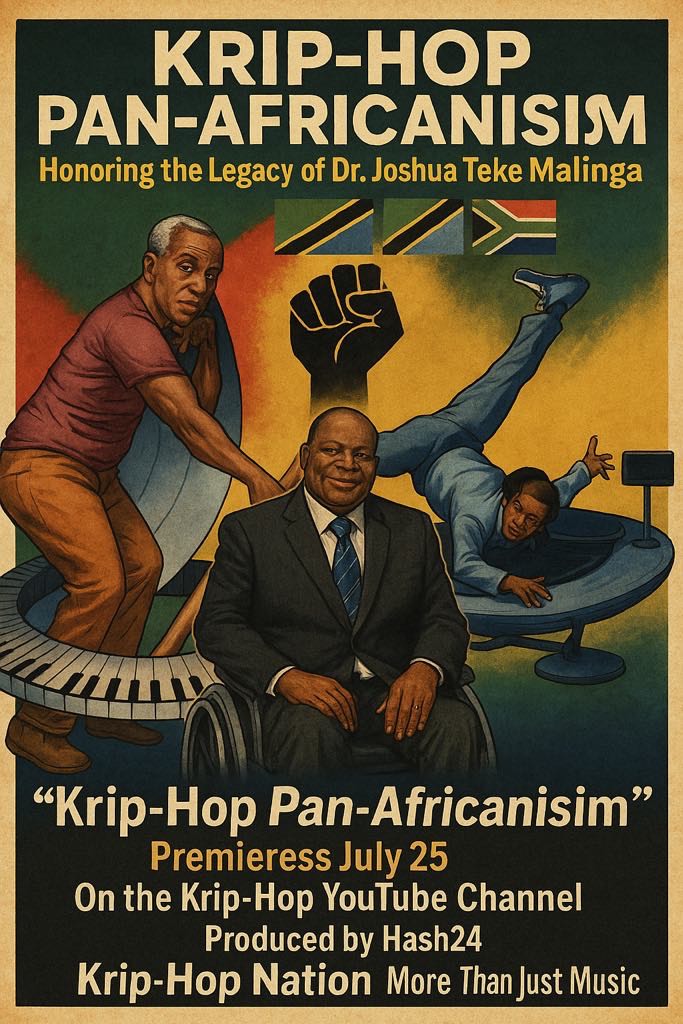
What Will Be Krip-Hop Pan-Africanism
First: Krip-Hop Nation is building on Dr. Joshua Teke Malinga and to expand his Pan African Federation of the Disabled throughout Krip-Hop’s African Chapters then globally what will be Called Krip-Hop Pan-Africanism.
Second: language, like other oppressed groups, was taken from people with disabilities and was turned on us to oppress us. From time immemorial, people with disabilities have been treated as outcasts, imbecilic, a curse from the gods, crazy, asexual),Before people with disabilities had civil rights, a movement and arts nationally and internationally, many had placed labels on us like “crazy”, “lame”, “cripple” and “retarded”, etc. The development of strong disability movements during the 1970s onwards has made possible the promotion of the human rights of people with disabilities. These emerged from the conditions of charity, discrimination and isolation that were, and still are, prevalent around the world. Of course, now with our civil rights and disability studies and culture, we have named ourselves and have used the negative terms to our own benefit to not only shock people but to respect that these words are our history and we must reclaim them.
Disability is slowly evolving and is now seen as a political, developmental, socio-economic and human rights issue supported by a paradigm shift from treating disability as a welfare and medical issue to a socio-economic and political issue. Through this new paradigm, people with disabilities are no longer seen as sick people who need perpetual treatment, rehabilitation and institutionalisation, but as citizens with rights first and foremost, and clients of social services last.
On the other hand I realize that international solidarity with terminology and history is tricky but we can come close to a commonality well; respecting our differences just like in Hip-Hop you turn something that the so-called mainstream has discarded with a fresh spotlight, taking these lemons and made our own lemonade; thus changing the C to a K in what we know today as Krip-Hop and now Afro-Krip
Under Krip-Hop term Afro-Krip that means the following:
Afro-Krip, a term I thought of (2016) to help unite Afro disabled people around the African diaspora associated with Krip-Hop during and after becoming politicized. As a Black disabled activist/artist living in America having a need and vision of connecting with other artists with disabilities /activists in the African diaspora realized there must be terminology that speaks to our experiences.
As we know the African diaspora refers to the communities throughout the world that have resulted from descent from the movement in historic times of peoples from Africa, predominantly to the Americas, Europe, Asia, and the Middle East, among other areas around the globe. The term has been historically applied in particular to the descendants of the West and Central Africans who were enslaved and shipped to the Americas in the Atlantic slave trade, with their largest populations in Brazil (see Afro-Brazilian), followed by the USA and others. Some scholars identify “four circulatory phases” of migration out of Africa.
So it makes sense that people with disabilities, our culture and activism are also a part of this African diaspora and we share stories and also create realities of today. So because of the above, I want to add a term, Afro-Krip as one culture aspect of/under African Diaspora Culture with a focus on disability through activism, art, music and such.
In my vision there is a process or steps to get to Afro-Krip at the highest level, a common political stage where the person is comfortable with their identity as a person with a disability and are throwing off the mainstream brainwashing of overcoming or hiding disability to also reach beyond themselves to others for community and discovery of history building on arts and struggles of our African disabled ancestors.
With this term Afro-Krip we need to know why the term Krip knows that it has an ugly history. Why Krip with a K? Like there is a process or steps to get to Afro-Krip at the highest level is a common political stage where the person is comfortable with their identity as a person with a disability and is throwing off the mainstream brainwashing of overcoming or hiding disability. Like I said, we are taking back our language that was used against us like the term cripple to flip it into a positive and empowerment aka cripple to Krip, we also at the same time honoring some of our Black disabled ancestors that used the term cripple like jazz musician, Clarence Lofton (March 28, 1887,[1]1896 or 1897 – January 9, 1957) and dancer, Henry “Crip” Heard (November 11, 1924 – September 11, 1991) to name a few.
What is Black Ableism
“Black ableism,” a concept that I have been writing about for years (Moore 2024). Black ableism is a form of discrimination and social prejudice specifically against Black people with disabilities, perpetrated by non-disabled Black individuals.
I helped coin this concept, addressing the unique historical and cultural context of ableism within the Black community, tracing its roots to slavery and the subsequent internalization of negative perceptions of disability.
Since the 1980s I have worked in both my disability and Black community. Most of my activism and cultural work has been aimed to change my communities based on my identity as a disabled Black man. My work has mostly opened avenues in the disability community, including non-profits by utilizing cultural events, research books/literature and disability studies. In the mid 1990s after feeling used and discriminated against by dominant disability nonprofits I founded Disability Advocates of Minorities Organization (DAMO) which was active for four years. DAMO was established for people of color with disabilities and the greater Black community. Upon evaluation of DAMO I realized I have been running away from my Black community because of open wounds unknowingly inflicted by them through forms of Black ableism.
As we know, terminology and the power of defining language are really important. Most often new terminology comes from the streets. Often academia adopts this language therefore giving legitimacy to the work of disabled folks without acknowledging their work. Most areas of disability have been taken from us, including the medical industry, and professionals/experts etc. Until we take it back, redefine it, politicize it, and sometimes change it all together our work will continue to belong to others.
Although the term Ableism has been defined by disability advocates from dominant culture, if you put Black in front of anything coming out of disability it must first be stripped down then reshaped in the experiences, histories and words from the Black disabled experience. By now, we must know that the Black disabled experience around the world has different roots than our White disabled counterparts. Because of the need of Black disabled people to heal our wounds inflicted by our Black community, one by one or collectively, it is imperative that we tell our stories and define new terminology, definitions, art, music, political views, and provide education and resources for our Black community. Many Black disabled people have had these same thoughts.
According to a Black disabled lawyer educator and organizer from the US, Talila Lewis’s working definition of ableism is:
“A system of assigning value to people’s bodies and minds based on societally constructed ideas of normalcy, productivity, desirability, intelligence, excellence, and fitness. These constructed ideas are deeply rooted in eugenics, anti-Blackness, misogyny, colonialism, imperialism, and capitalism. This systemic oppression leads to people and society determining people’s value based on their culture, age, language, appearance, religion, birth or living place, “health/wellness”, and/or their ability to satisfactorily re/produce, “excel” and “behave.” You do not have to be disabled to experience ableism.” (2022)
If we view this definition from the perspective of the Black experience reaching back from the capture and shipping of slaves to the teaching of disability and our bodies, almost everything we have done has helped shape Black ableism toward Black disabled people. Due to the lack of awareness of race and racism that continues to exist in the disability rights movement, it is not surprising that the Black community has not made steps to recognize their own ableism.
I have defined Black ableism as: Discrimination and social prejudice against Black people with disabilities or who are perceived to have disabilities from Black non-disabled people as far back as slavery. For example, slave owners used disability as a reason to devalue a slave because of what he/she could contribute to the plantation. And as we, a new people emerged out of slavery and saw by the slave master’s example that disability meant devalued. Therefore slaves internalized disability was a sin, something that needs to be healed using the outdated Religious Model of Disability mixed with The Tragedy/Charity Model of disability that says the following: The idea that disability is essentially a test of faith or even salvation in nature. If the person does not experience the physical healing of their disability, he or she is regarded as having a lack of faith in God. Mix with depicting disabled people as victims of circumstance, deserving of pity.
Unchallenged Black ableism not only holds the Black community from advancing the project of justice for all its members, but it also makes the Black community hurtful and irrelevant for the Black disabled people and their families. Black Ableism can cause many deep-rooted problems in a Black disabled person. The problems are as broad as low self-esteem, to trying to reach the unreachable, also known as overcoming or hiding their disability, to most importantly, not having a community. Ableism, like racism, manifests from individual to institutional, where it corrupts Black institutions.
Black ableism can only be eradicated by stripping what the Black community has been taught about disability through the lens of oppression and then rebuilding. This rebuilding process must be conducted by coordinated teams of Black disabled people and family members who have had a presence in both the disability and Black communities. Also, part of the formula includes individuals who have held on to their identity politics and have a disability vision and reality for the Black community. In other words individuals who have a deep rooted love of their community and are willing to risk exposing their pain to help the Black community have an understanding of disability from a race and culture perspective. This process will be a long term commitment to healing and detailing the historical significance of disability to present day issues, including Black ableism. For Black disabled people and our families the rebuilding will lead to a path of Black disabled empowerment and a commonality with our Black community. The Black community will be all the richer by embracing their disabled sisters and brothers from a historical, political, participatory and cultural way of life.
Krip-Hop Pan-Africanism mission is:
- To connect likeminded disabled African artists in the African diaspora including Africa, United States, Brazil, Jamaica, Cuba, Mexico, United Kingdom and more.
- To promote unity, disabled ancestry, disability rights and Black disability culture.
- To help implement the United Nation Treaty on Disability especially title thirty-two that refers to the arts.
- To help erase Black ableism.
- To educate Black communities on Black disabled issues.
- To advocate and participate in the arts arena from music to visual arts etc.
- To provide political Black disability education locally and globally.
- To be a source of support and education to Black disabled peoples especially our Black disabled youth and young adults.
Our beliefs
Black disabled people have a long history so we disbunk the notion of inclusion, we strive for liberation.
Our disability is political, historical and cultural.
From an “I” story to a “we” story connecting internationally.
Language is important thus taking back our language even negative terms to flip it into empowerment like Krip.
Coming out of the White western colonization to create Black disabled theories, terminology and framework etc..
Solidarity
Open communication.
To hold each other as we bring people through the stages, reaching Up To Black Krip Radicalization.
Once again, Krip-Hop Nation is building on Dr. Joshua Teke Malinga and to Expand his Pan African Federation of the Disabled Throughout Krip-Hop’s African Chapters then Globally what will be Called Krip-Hop Pan-Africanism.