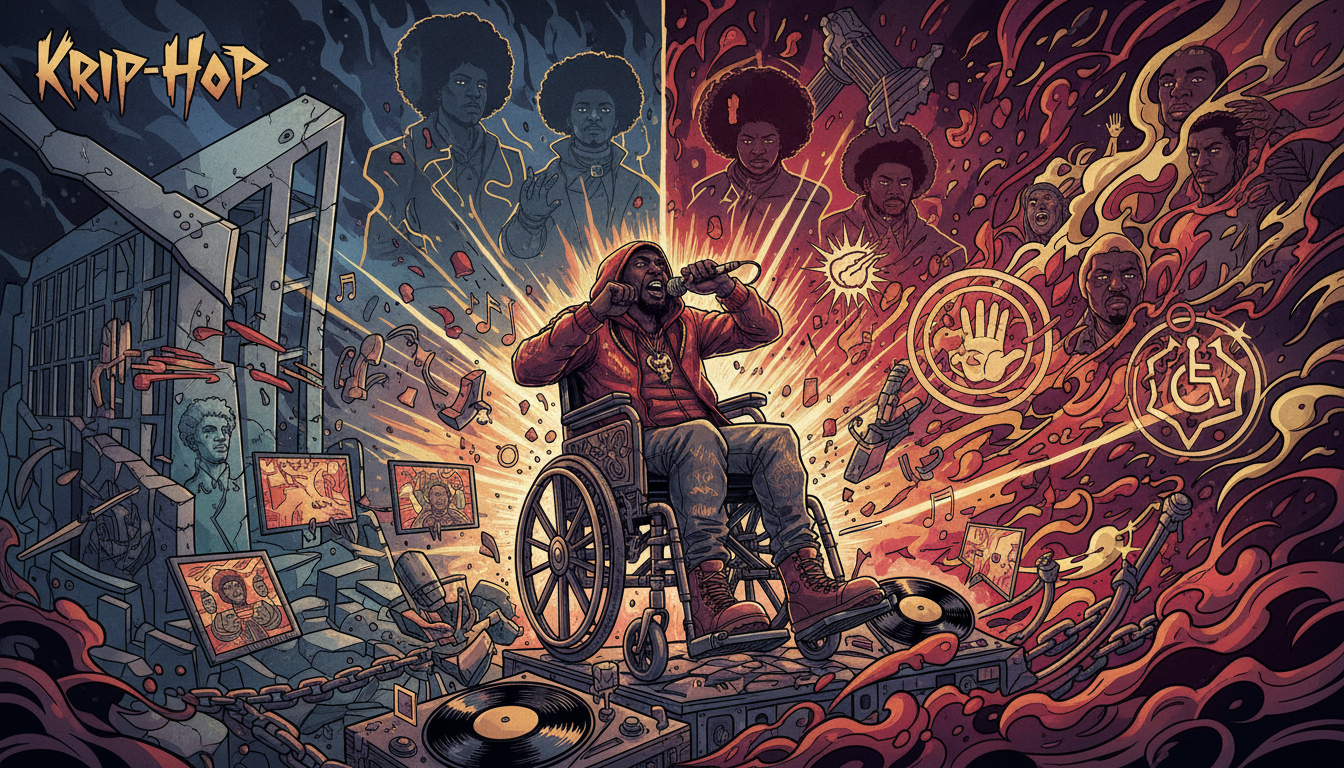
Krip-Hop Theory Concepts
Krip-Hop theory centers on disabled Black artists using hip-hop to challenge ableism, racism, and mainstream narratives, reclaiming disabled identity by embracing terms like “krip,” demanding liberation rather than mere inclusion, and connecting with Black disabled ancestors for political education, cultural expression, and radical transformation, advocating for disability justice and disrupting societal “identity thinking” through music, art, and activism.
The core concepts and terminologies of Krip-Hop theory are as follows. Liberation, not inclusion: moving beyond simple accommodation to demand fundamental societal transformation and challenge ableist systems that marginalize disabled people of color. Ancestral connection: honoring Black disabled figures from history, such as Elias Hill and Audre Lorde, to build on their legacies and understand the historical roots of disability activism. Challenging media and norms: actively disrupting how disability and Blackness are framed in media, advocating for authentic representation and countering ableist and racist stereotypes. Art as activism: using hip-hop elements like rapping and DJing as tools for political education, cultural empowerment, and community building.
The framework is rooted in Disability Justice, incorporating principles such as decolonizing, leadership from the margins, and anti-capitalism into Krip-Hop’s political vision. “Kripping” theory means applying a disabled, Black lens to existing radical theories, such as Frantz Fanon’s decolonizing work and Gloria Ladson-Billings’ culturally relevant pedagogy, to generate new ways of understanding and fighting oppression.
Reclamation and empowerment appear as artists use hip-hop to share lived experiences with discrimination, fight stigma, and assert their humanity. Decolonizing means recognizing that Black communities were colonized not only physically but also in their thinking about disability, shaped by the colonizer’s ableist, eugenic, and silencing practices. Therefore, Black and other communities of color must undergo a decolonizing process to reject harmful colonial outlooks, histories, and terminologies about disability. Krip-Hop functions as a cultural and political platform, providing space for activism, education, and artistic creation that reflects disabled perspectives while connecting with broader disability justice movements.