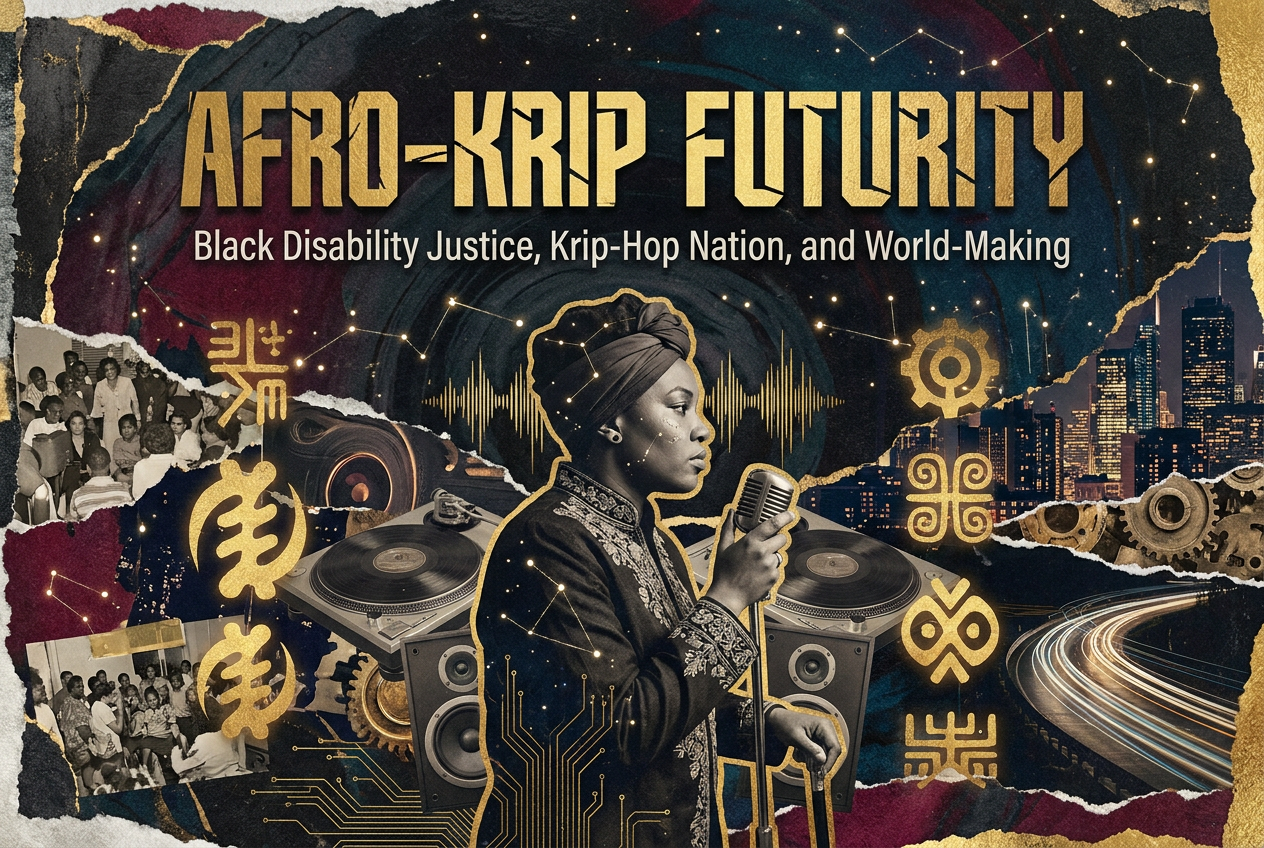
Afro-Krip Futurity
Afro-Krip futurity names a way of imagining and enacting futures in which Black disabled life is not organized around survival under oppression, but around possibility, creativity, and self-determined existence. It emerges from the fusion of Afro-pessimist attention to the structural conditions of Black life, Black radical traditions of world-making, and crip theory’s insistence that disability is not a deficit but a site of knowledge, adaptation, and resistance. As a concept, it is less about predicting a distant future and more about identifying how alternative futures are already being practiced in the present through culture, language, and collective life.
At its core, Afro-Krip futurity begins from a refusal. It rejects the idea that disability, particularly Black disability, is something to be cured, erased, or transcended in order to access a meaningful future. Instead, it insists that disabled Black embodiment is itself a generative ground for imagining new social relations. Where dominant futurisms often rely on ideals of technological enhancement, bodily perfection, or post-racial transcendence, Afro-Krip futurity centers bodies that are marked by injury, chronic illness, neurodivergence, and state violence. These are not framed as limitations but as sites through which alternative modes of time, movement, and sociality are produced.
One of the defining features of Afro-Krip futurity is its reconfiguration of time. Disabled experience often disrupts linear, productivity-driven notions of time what disability scholars call “crip time.” Afro-Krip futurity extends this disruption by situating it within the historical conditions of Black life, where time has already been fractured by slavery, incarceration, and premature death. Rather than striving to “catch up” to normative timelines, Afro-Krip futurity values slowness, repetition, improvisation, and pause as meaningful temporalities. In cultural forms like Hip-Hop, this can be heard in altered rhythms, unconventional flows, and lyrical attention to endurance and care rather than speed and dominance.
Afro-Krip futurity is also deeply tied to the body as an archive. It recognizes that Black disabled bodies carry the material traces of historical and ongoing violence policing, environmental racism, medical neglect but it refuses to let those traces define the limits of possibility. Instead, the body becomes a site of speculative practice. Through performance, music, and storytelling, artists enact versions of themselves and their communities that exceed the conditions imposed upon them. These enactments are not escapist; they are grounded in lived reality while simultaneously pushing beyond it.
Within Krip-Hop Nation, Afro-Krip futurity is practiced through artistic production that centers disabled Black voices and aesthetics. Artists do not simply narrate trauma; they transform it into creative force. The stage, the track, and the cipher become spaces where new forms of belonging are rehearsed. Accessibility itself becomes part of the aesthetic whether through modified performance styles, collaborative structures, or the integration of assistive technologies signaling a future in which access is not an afterthought but a foundational principle.
Another crucial dimension of Afro-Krip futurity is its collective orientation. It resists individualistic narratives of overcoming or inspirational triumph that often dominate disability representation. Instead, it emphasizes interdependence, care networks, and community-based survival strategies. The future it imagines is not one where disabled individuals assimilate into existing systems, but one where those systems are transformed to support a wider range of bodies and minds. This aligns with disability justice frameworks that prioritize collective access and mutual aid over independence as an ideal.
Afro-Krip futurity also reframes the relationship between violence and possibility. It acknowledges that systems like policing, incarceration, and economic exploitation continue to produce disability within Black communities. However, rather than allowing this reality to foreclose the future, Afro-Krip futurity treats it as a condition that demands new forms of resistance and imagination. Cultural production becomes a way of documenting harm while simultaneously asserting that Black disabled life will continue to create, connect, and envision otherwise.
Ultimately, Afro-Krip futurity is both a critical and creative practice. It critiques the ableist and anti-Black assumptions embedded in dominant visions of the future while actively constructing alternatives through everyday practices and artistic expression. It asks not what the future will look like for Black disabled people within existing systems, but what kinds of worlds become possible when their experiences, knowledge, and creativity are placed at the center.
Lets go deeper within Disability Justice and Krip-Hop Nation
Afro-Krip futurity is not an abstract add-on to Krip-Hop Nation or Disability Justice, it is the horizon that gives both their political and cultural work direction. It provides the imaginative and methodological framework through which Krip-Hop Nation’s artistic practices and Disability Justice’s organizing principles converge, particularly around the question of what kinds of worlds become possible when disabled Black life is centered rather than marginalized.
Within Krip-Hop Nation, Afro-Krip futurity operates as an aesthetic and performative practice. Krip-Hop has always been more than a genre or collective; it is a reconfiguration of Hip-Hop’s sensory and bodily norms. Afro-Krip futurity deepens this by framing those reconfigurations as anticipations of a different world. When Krip-Hop artists alter flow, pacing, breath control, or performance structure in response to disability, they are not simply adapting to limitation they are producing new artistic standards that refuse able-bodied dominance. These practices model a future in which access and variation are not exceptions but the baseline of cultural production. The cipher, the stage, and the recording become spaces where that future is rehearsed in real time.
This is where Afro-Krip futurity aligns closely with Disability Justice. Disability Justice, as a framework, insists on intersectionality, collective access, and the leadership of those most impacted particularly queer, trans, and Black disabled people. Afro-Krip futurity gives this framework a cultural and imaginative dimension. It translates principles like interdependence and collective care into lived, expressive forms. Where Disability Justice might articulate the need for accessible communities, Afro-Krip futurity shows what those communities feel and sound like through music, performance, and storytelling.
The connection is especially clear around the concept of access. In mainstream contexts, access is often treated as an accommodation added after the fact. Both Krip-Hop Nation and Disability Justice reject this model. Afro-Krip futurity pushes further by imagining access as a generative force something that shapes the very form of cultural and social life from the outset. In Krip-Hop practice, this might look like performances built around diverse bodily capacities, collaborative creation that distributes labor across different abilities, or the integration of assistive technologies as creative tools rather than stigmatized devices. These are not just inclusive practices; they are prototypes of a future where access structures everything.
Afro-Krip futurity also helps bridge the political and the cultural by reframing survival as world-making. Disability Justice often addresses the material conditions of survival healthcare, housing, protection from violence while Krip-Hop Nation documents and resists those conditions through art. Afro-Krip futurity connects these by insisting that survival practices already contain the seeds of alternative futures. Mutual aid networks, care webs, and community-based knowledge are not only responses to crisis; they are blueprints for different social arrangements. Krip-Hop’s artistic output amplifies and circulates these blueprints, making them audible and visible.
Another key point of convergence is the treatment of state violence, particularly policing. Both Krip-Hop Nation and Disability Justice recognize that systems of policing and incarceration are deeply ableist and racialized, producing disability through physical harm, psychological trauma, and neglect. Afro-Krip futurity intervenes by refusing to let this violence define the limits of possibility. Instead, it frames resistance as simultaneously oppositional and generative. Cultural production becomes a way to document harm while also asserting that Black disabled life will continue to imagine and enact alternatives beyond policing and carcerality.
Finally, Afro-Krip futurity reinforces the collective orientation shared by Krip-Hop Nation and Disability Justice. It resists narratives of individual overcoming and instead emphasizes interdependence as a fundamental social principle. In Krip-Hop spaces, this is evident in collaborative performance and shared authorship; in Disability Justice, it appears in organizing models that prioritize community care over independence. Afro-Krip futurity brings these into alignment by imagining a future where interdependence is not a compromise but a desired and valued mode of existence.
In this way, Afro-Krip futurity functions as the connective tissue between Krip-Hop Nation’s cultural praxis and Disability Justice’s political framework. It ensures that the work is not only about critiquing the present but also about actively constructing and inhabiting alternative futures futures where Black disabled people are not merely included, but are central to how culture, community, and social life are defined.
Let’s complicate it by bringing in the tension of decolonizing Black ableism.
Afro-Krip Futurity, Disability Justice, and the Tension of Decolonizing Black Ableism
Afro-Krip futurity, when read through the political commitments of Krip-Hop Nation and the Disability Justice principles articulated by Sins Invalid, not only reveals deep alignment but also exposes an important tension particularly around Krip-Hop’s insistence that Black communities must actively decolonize their thinking about disability, and how this demand can sit uneasily within dominant deployments of intersectionality.
Krip-Hop Nation’s political stance is clear: anti-Black racism alone does not explain the marginalization of disabled Black people. There is also a need to confront Black ableism the ways ableist values have been internalized within Black communities as a survival response to colonialism, slavery, and racial capitalism. These values often privilege strength, productivity, and bodily resilience, framing disability as weakness, shame, or failure. From a Krip-Hop perspective, this is not simply a byproduct of oppression; it is an active terrain of struggle that must be named and transformed.
This is where the call for decolonizing disability consciousness emerges. For Krip-Hop, decolonization is not only about resisting white supremacy externally; it is also about dismantling the colonial logics that shape how Black communities understand the body, value, and worth. Colonialism imposed rigid hierarchies of ability, productivity, and normalcy, and these hierarchies continue to structure both institutional systems and community norms. Afro-Krip futurity extends this critique by insisting that a liberated future cannot be built if disability remains stigmatized within Black life itself. In this sense, decolonization requires a radical reorientation: disability must be understood not as deficit, but as a valid and valuable mode of being.
However, this insistence introduces a productive friction with how intersectionality is sometimes practiced within Disability Justice spaces. The principle of intersectionality, central to Sins Invalid, emphasizes that systems of oppression, racism, ableism, sexism, classism are interconnected and cannot be analyzed in isolation. It calls for solidarity and an understanding that marginalized communities are shaped by overlapping structures of domination. Yet, in practice, intersectionality can sometimes lean toward protecting marginalized communities from critique, particularly when that critique risks being perceived as divisive or as reinforcing racist narratives.
Krip-Hop Nation pushes against this limitation. It argues that without directly naming and confronting Black ableism, intersectionality risks becoming descriptive rather than transformative. In other words, it can map oppression without fully addressing how oppression is also reproduced internally within marginalized groups. Afro-Krip futurity sharpens this point by insisting that the future cannot be built on unexamined contradictions. If disabled Black people are marginalized within Black spaces, then liberation requires not only external resistance but also internal accountability.
This does not mean that Krip-Hop rejects intersectionality outright. Rather, it calls for a more rigorous, decolonized intersectionality one that can hold complexity without collapsing into silence. Afro-Krip futurity helps mediate this tension by reframing critique as a form of care and collective survival rather than division. To name Black ableism is not to pathologize Black communities; it is to refuse the colonial conditions that have made ableism seem necessary or natural. It is an act of reclamation, insisting that Blackness itself must be expansive enough to include disability in all its forms.
At the same time, the principles of Sins Invalid particularly those of wholeness, interdependence, and collective liberation offer a crucial counterbalance. They remind us that critique must remain grounded in love, accountability, and a commitment to not reproducing harm. Afro-Krip futurity aligns with this by emphasizing that decolonization is not about fragmentation, but about transformation. The goal is not to isolate disabled Black people from their communities, but to remake those communities so that disability is no longer a site of exclusion.
This tension ultimately reveals something generative rather than contradictory. Afro-Krip futurity thrives in this space of friction. It demands that Disability Justice remain accountable to the specific conditions of Black life, while also pushing Krip-Hop Nation to situate its critique within a broader framework of solidarity and interconnected struggle. Together, they produce a more nuanced political vision one that recognizes that liberation requires both confronting external systems of oppression and transforming internalized structures of thought.
In this way, Afro-Krip futurity becomes a site of both convergence and challenge. It affirms the foundational insights of Disability Justice while insisting that those insights must be continually deepened through a direct engagement with Black ableism and the ongoing project of decolonizing the Black imagination around disability.