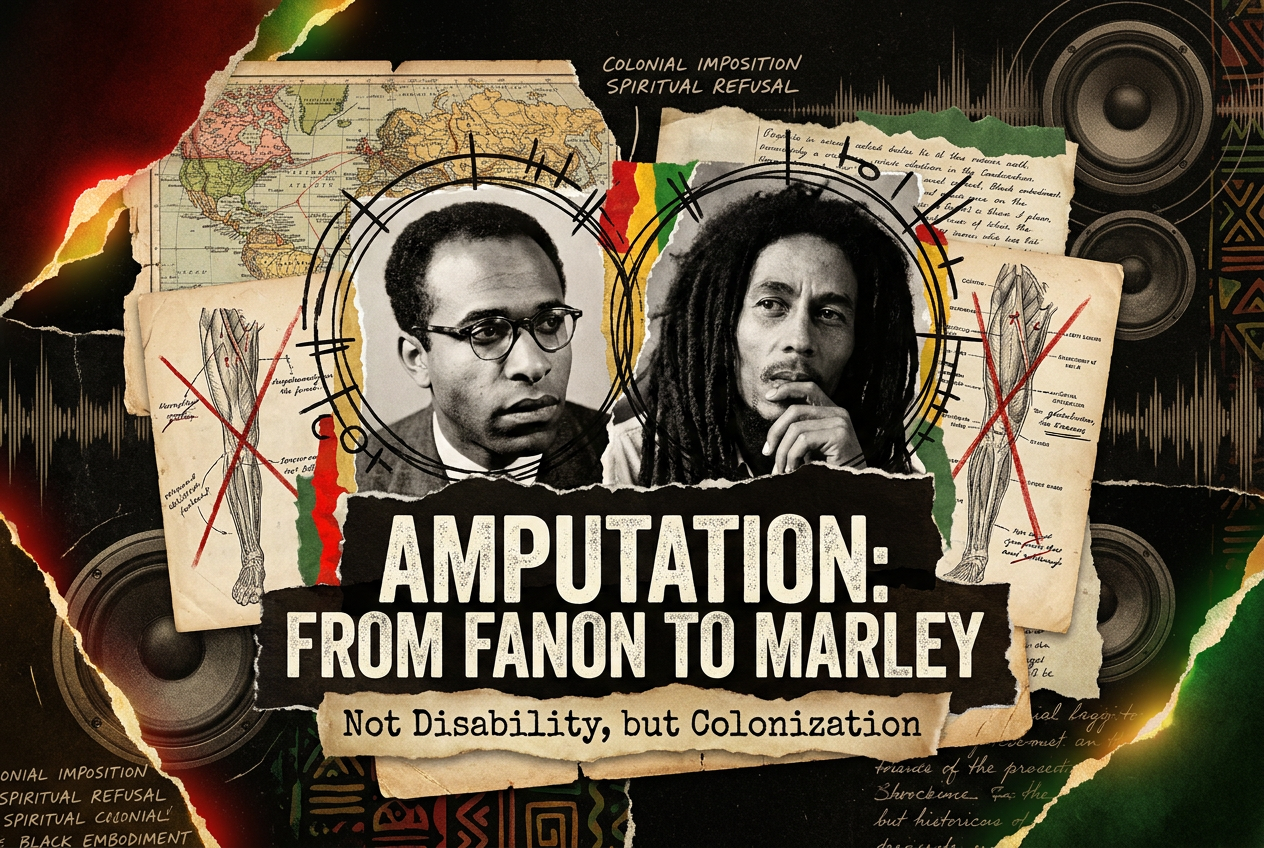
Amputation: From Frantz Fanon to Bob Marley — Not Disability, but Colonization
This essay argues that the refusals of amputation by Frantz Fanon and Bob Marley should not be understood as rejections of disability itself, but rather as political and cultural refusals of colonial domination over the Black body. By situating their decisions within the frameworks of colonialism, race, and Rastafarianism, I contend that these acts reveal how disability, when imposed or interpreted through a colonial lens, becomes entangled with dehumanization. Ultimately, this analysis points to the need for a decolonized understanding of disability within Black communities.
Frantz Fanon’s psychiatric work in Algeria provides a critical foundation for this argument. At the Blida-Joinville Hospital, Fanon developed “sociotherapy” as a response to the psychological violence of colonialism (Fanon 1965; Macey 2000). Rejecting purely biomedical models, he emphasized cultural expression, storytelling, and collective social practices as essential to healing. For Fanon, mental health could not be separated from the sociopolitical conditions of oppression; the colonized subject’s psyche was shaped and wounded by colonial power (Fanon 1965).
This insight extends into Fanon’s theoretical work, particularly in Black Skin, White Masks. There, he articulates how the Black body is constructed under the “white gaze,” effectively disrupting what he calls the body schema (Fanon 1967). In this framework, Black embodiment is rendered fragmented, objectified, and metaphorically “crippled.” His reference to the white amputee soldier who is expected to adapt to bodily loss serves as a critical contrast (Fanon 1967, 112–14). Fanon refuses both the literal and symbolic logic of amputation, rejecting the idea that one must accept reduction or loss in order to exist within a white-defined world. Instead, he asserts a form of subjectivity that exceeds these imposed limits, claiming a selfhood “as vast as the world” (Fanon 1967, 229).
Bob Marley’s refusal of amputation, though grounded in a different context, reflects a parallel resistance. Diagnosed with acral lentiginous melanoma later in life, Marley declined amputation in accordance with Rastafarian beliefs, which emphasize the spiritual integrity of the body (White 2006). However, his stance cannot be reduced to religious doctrine alone. Marley’s broader actions, such as the 1979 concert at Madison Square Garden, where he reportedly brought an eleven-year-old girl with spina bifida onstage, demonstrate an inclusive vision of embodiment that affirms, rather than rejects, disability. His statement that his music was “for everyone” underscores this ethos (White 2006).
Thus, both Fanon and Marley distinguish between disability as lived experience and disability as framed by colonial or oppressive structures. Their refusals of amputation should be read not as denials of disabled existence, but as refusals of what amputation symbolized within their respective contexts: a forced accommodation to systems that diminish Black humanity.
This distinction becomes clearer when considered alongside the work of Sharon Elise, who analyzes racial power through the metaphor of a “game” in her essay on Drylongso by John Langston Gwaltney. Elise, drawing on Fanon, argues that Black individuals are born into a structurally unequal system, a “losing hand” in which white privilege operates as an unspoken but decisive advantage (Elise 1999). Importantly, this framework suggests that even when white individuals experience disability, they do so within a system that still confers racial privilege.
From this perspective, Fanon’s comparison to the white amputee soldier reveals a deeper critique: disability does not erase racial hierarchy. The white disabled subject remains positioned within structures of privilege, whereas the Black subject confronts both racialization and bodily marginalization. Therefore, Fanon’s refusal can be interpreted as a rejection of a system that demands acceptance of loss without addressing the unequal conditions under which that loss is experienced.
This framework also resonates with contemporary Afro-Krip and Krip-Hop scholarship, particularly the work of Leroy F. Moore Jr., which argues that disability within Black communities cannot be separated from histories of colonialism, state violence, racism, and cultural exclusion. Krip-Hop Nation reframes disability not as individual tragedy but as a site of political consciousness, cultural production, and decolonial resistance (Moore 2015). Through this lens, Fanon and Marley’s refusals are not anti-disability acts; rather, they are critiques of the colonial conditions that define which bodies are considered whole, valuable, or human.
In conclusion, the refusals of amputation by Fanon and Marley illuminate the intersection of race, colonialism, and disability in ways that challenge dominant narratives. Rather than framing their decisions as oppositional to disability, this essay has argued that they resist the colonial meanings imposed onto the Black body. Their actions call for a rethinking of disability that is attentive to historical and racial contexts—one that moves toward a decolonized understanding of embodiment within Black communities.
To be continued…
References
Elise, Sharon. 1999. “The Black Masculine Body: Body, Identity, and Representation in John Langston Gwaltney’s Drylongso.” In Race, Gender, and Power in America, edited by Anita Faye Hill and Emma Coleman Jordan. New York: Oxford University Press.
Fanon, Frantz. 1965. A Dying Colonialism. Translated by Haakon Chevalier. New York: Grove Press.
Fanon, Frantz. 1967. Black Skin, White Masks. Translated by Charles Lam Markmann. New York: Grove Press.