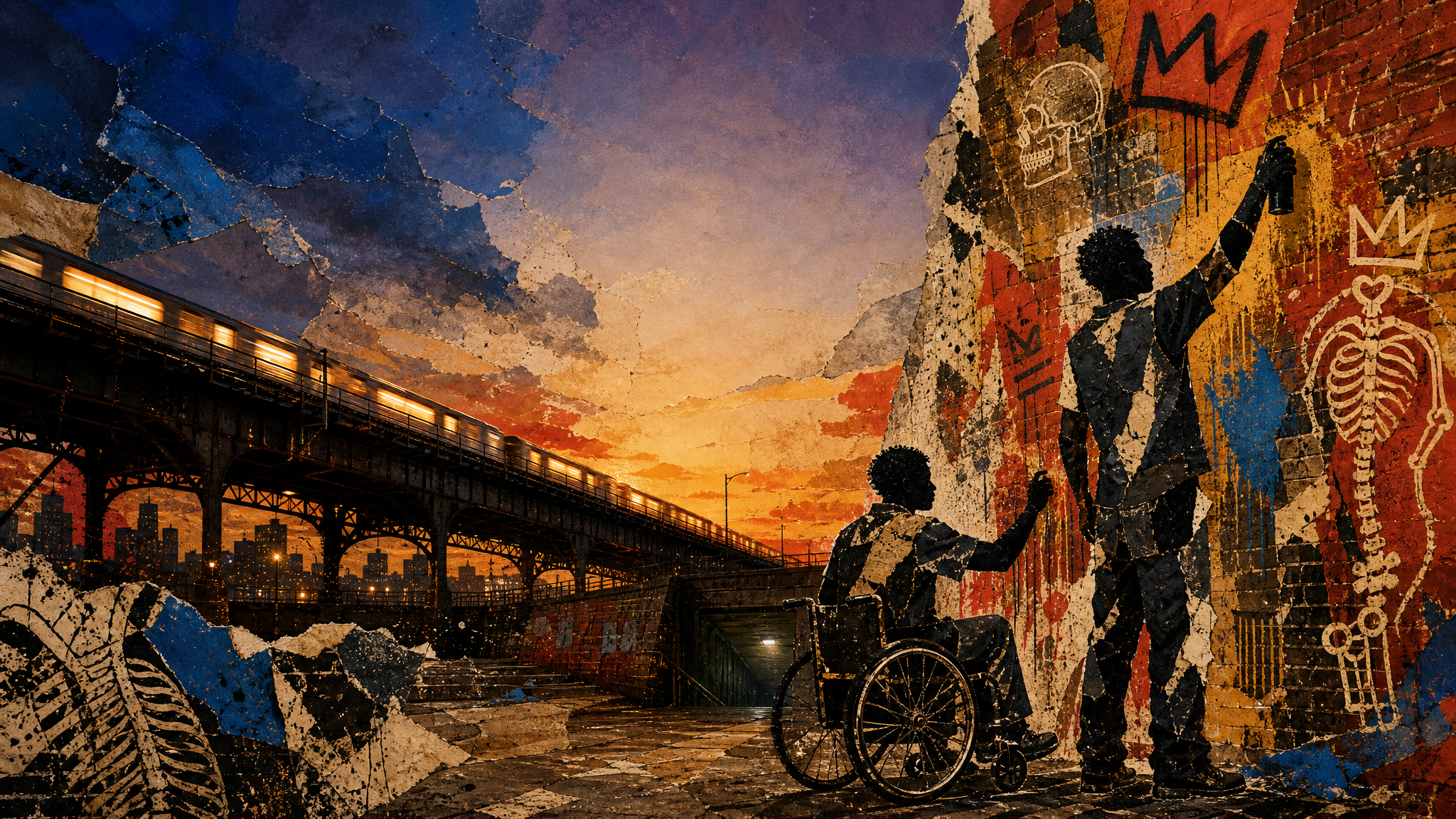
Kase2, Basquiat, and the Making of Krip-Hop History
Hip-Hop history often celebrates the visible pioneers who transformed New York City’s streets, trains, walls, and stages into cultural landscapes. Yet hidden within that history are disability narratives that have rarely been acknowledged. Two artists who embody this overlooked connection are Jean-Michel Basquiat and Kase2 aka Jeff Brown. Although they worked in different artistic circles and never publicly collaborated, their lives reveal striking parallels that help expand our understanding of Hip-Hop through a disability lens.
Basquiat’s accident occurred when he was seven years old. During his recovery, his mother introduced him to Gray’s Anatomy, a book that would influence his artwork for the rest of his life. His paintings became filled with skeletons, bones, organs, scars, and fragmented bodies. Through a Krip-Hop lens, these images can be understood as traces of a childhood encounter with trauma, injury, and bodily vulnerability. Disability was not absent from Basquiat’s work; it was embedded within it.
Basquiat’s connection to disability was also shaped by his mother, Matilde Andrades Basquiat, who experienced mental health disabilities and periods of institutionalization. Her influence on his artistic development was profound. Krip-Hop recognizes mental health disability as part of disability history and understands that Basquiat’s artistic vision emerged from a family history shaped by both creativity and disability.
Both artists were shaped by traumatic accidents in the late 1970s that permanently altered their bodies. Kase2 lost his right arm after an accident in the subway tunnel in New York City. These experiences were not simply biographical details; they became part of how each artist moved through the world and created art. Their bodies carried the marks of survival, resilience, and adaptation.
These parallels inspired my poem, On the Street, In A Subway:
On the Street, In A Subway
Two in the late seventies
Both visual artists
Under bridges under the underground
Straight lines from crush spine and arm
On the Street, In A Subway
They were the the fourth element
Their bodies became different
Art to pay rent
Two hits they left a dent
Bodies healed back
With a fused spine and one arm
To the streets, they came back
In the subway tunnel & under the bridge
They never met, I wonder why
Did they see each other’s art
Both are not with us
Time to say hi not bye bye
2021 it’s about time
To fuse the two into Krip-Hop history
And to add to Hip-Hop studies
Kase2 and Jean-Michel Basquiat bring them back under Krip-Hop pedagogy
The poem situates both artists within the physical geography of New York City the streets, bridges, and subway tunnels that gave birth to Hip-Hop culture. It also places disability at the center of their stories. Rather than viewing their impairments as tragic footnotes, the poem recognizes them as part of the lived realities that shaped their creative practices.
Kase2 became one of graffiti’s most innovative figures, developing his distinctive “Computer Rock” style while painting with one arm that you can see in the first film documentary on graffiti entitled, Style Wars where he talked about that accident and so much more. His work challenged assumptions about what disabled bodies could do within a culture that prized physical daring and visibility. Basquiat transformed his experiences into paintings that reflected fractured bodies, urban life, and Black survival. Though not usually discussed as a disabled artist, his life was marked by bodily trauma that influenced his understanding of vulnerability and existence.
For Krip-Hop pedagogy, these stories matter because they challenge the ableist assumptions embedded within both Hip-Hop studies and art history. By bringing Kase2 and Basquiat together, we uncover a hidden genealogy of disability within Hip-Hop culture. Their lives demonstrate that disabled artists were not outsiders to Hip-Hop’s development; they were creators, innovators, and cultural workers who helped shape its visual language.
The fact that Kase2 and Basquiat never met makes their connection even more compelling. They occupied the same city, worked within overlapping artistic worlds, and shared experiences of bodily transformation, yet history never formally linked them. Krip-Hop Theory creates a space where these connections can be made. It allows us to revisit Hip-Hop’s past and recognize how disability has always been present within its foundations.
By fusing Kase2 and Basquiat into Krip-Hop history, we expand the archive of Hip-Hop studies and contribute to a broader Black Krip Radical Tradition. Their stories remind us that survival, creativity, and resistance are often born from bodies that have been marked, injured, and transformed. Through Krip-Hop pedagogy, they return not simply as historical figures, but as teachers whose lives continue to challenge how we understand art, disability, and Black cultural expression. I’m so glad that I’m in contact with the filmmaker, Karen K. Merz who told me this:
Yaay!! You are the community I was looking to connect with. I could only find predominantly white disability groups a few years back when I was looking online, like on Facebook, etc. I saw Crip Camp and connected with Judy Heumann on IG at some point. That seemed like an integrated group, but still predominantly white. (Merz 2025)
So his experience of only finding White disability groups is a recent example of why we need safe places like the upcoming Krip-Hop Institute to support artists, including documentaries. This filmmaking is trying to do what Dr. Joy DeGru’s organization is about: truth-telling.