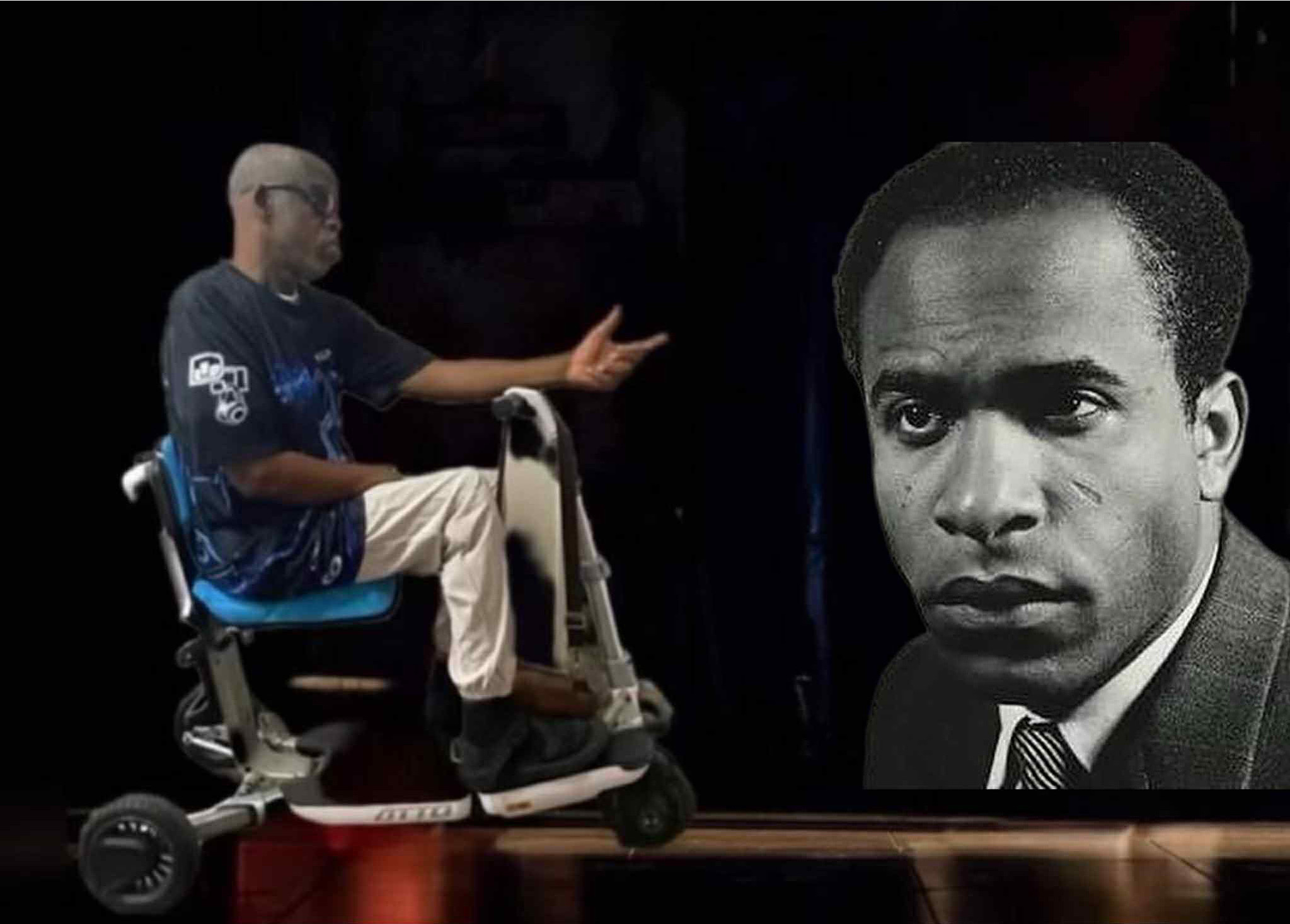
What Would Frantz Fanon Have Thought About Krip-Hop Nation
Frantz Fanon died in 1961, decades before Hip-Hop and Krip-Hop Nation emerged, so no one can know how he would have engaged with Krip-Hop Nation. However, based on his writings especially Black Skin, White Masks and The Wretched of the Earth we can make a historically grounded interpretation of how he might have viewed it.
From a Fanonian perspective, Krip-Hop Nation would likely be more than a music movement. It would represent a cultural and political practice of decolonization. Fanon argued that colonialism attacks not only land but also language, culture, the body, and the imagination. Krip-Hop Nation’s insistence that Black disabled people define themselves rather than accept labels imposed by medical institutions, charity organizations, or the state reflects a similar struggle over human dignity.
Fanon and the Colonial Construction of Disability
Fanon analyzed how colonialism classified people into hierarchies of worth. Although he did not develop a disability theory, his analysis can be extended to show how colonial societies also marked disabled bodies as inferior, dependent, and disposable.
He might have argued that colonial ableism produces what could be called a “colonized disabled consciousness”, where Black disabled people are taught to see themselves through the eyes of institutions that deny their humanity.
Krip-Hop Nation challenges that process by reclaiming identity through music, poetry, scholarship, and organizing.
Krip-Hop as Decolonizing Culture
Fanon believed revolutionary culture must emerge from oppressed people’s lived experiences.
He wrote that culture is not folklore preserved in a museum but something created through struggle.
From that perspective, Krip-Hop Nation could be understood as revolutionary culture because it transforms experiences of police violence, poverty, institutionalization, inaccessible education, and disability into political knowledge.
Instead of asking Black disabled people to assimilate into existing institutions, Krip-Hop creates new language, new art, and new political imagination.
Kripping Fanon’s Revolutionary Humanism
Fanon’s goal was the creation of what he called a “new humanity.”
Krip-Hop Nation extends that vision by insisting that this new humanity cannot exclude disabled people.
A Kripped reading of Fanon might ask:
● Can there be decolonization without disability liberation?
● Can there be Black liberation if Black disabled people remain invisible?
● Can revolutionary movements succeed while reproducing ableism?
Krip-Hop Nation answers these questions by insisting that disability is not a side issue but part of the struggle against colonialism, racism, capitalism, and state violence.
Fanon and Cultural Production
Fanon believed artists, writers, musicians, and intellectuals have responsibilities during liberation struggles.
He criticized artists who merely imitated European culture and celebrated those whose work emerged from the lives of oppressed communities.
He would likely recognize Krip-Hop artists as revolutionary cultural workers because they transform personal experiences into collective political consciousness.
In this sense, Krip-Hop Nation functions as both an artistic movement and a political school.
Guerrilla Intellectualism
My development of Krip-Hop Nation through community organizing, independent publishing, radio, workshops, oral history, and international collaboration closely resembles what Fanon envisioned as intellectual work rooted in struggle rather than detached academia.
Combined with Walter Rodney’s concept of guerrilla intellectualism, Fanon’s thought suggests that knowledge should circulate among the people rather than remain inside universities.
Krip-Hop Nation embodies this by producing theory from performances, conversations, archives, grassroots organizing, and the lived experiences of Black disabled communities.
Afro-Krip Consciousness
Perhaps Fanon would have viewed Afro-Krip Consciousness as an extension of his work on decolonizing the mind.
Where Fanon sought liberation from the psychological effects of colonial racism, Afro-Krip Consciousness also confronts internalized ableism.
This consciousness encourages Black disabled people to reject narratives of pity, tragedy, and dependency and instead embrace disability as a site of political identity, cultural creativity, and collective resistance.
Conclusion
Although we cannot know exactly what Frantz Fanon would have thought, his writings strongly suggest that he would have appreciated any movement committed to dismantling systems that deny human dignity and agency. Krip-Hop Nation can be understood as extending Fanon’s project into a domain he did not explicitly theorize: the liberation of Black disabled people.
In this reading, Krip-Hop Nation does not replace Fanon, it Krips Fanon. It expands his analysis of colonialism by demonstrating that colonial domination operates not only through race but also through disability. It argues that the “new humanity” Fanon envisioned can only be realized when Black disabled people are recognized not as objects of care or symbols of suffering, but as intellectuals, artists, organizers, and leaders whose experiences reshape the meaning of liberation itself.