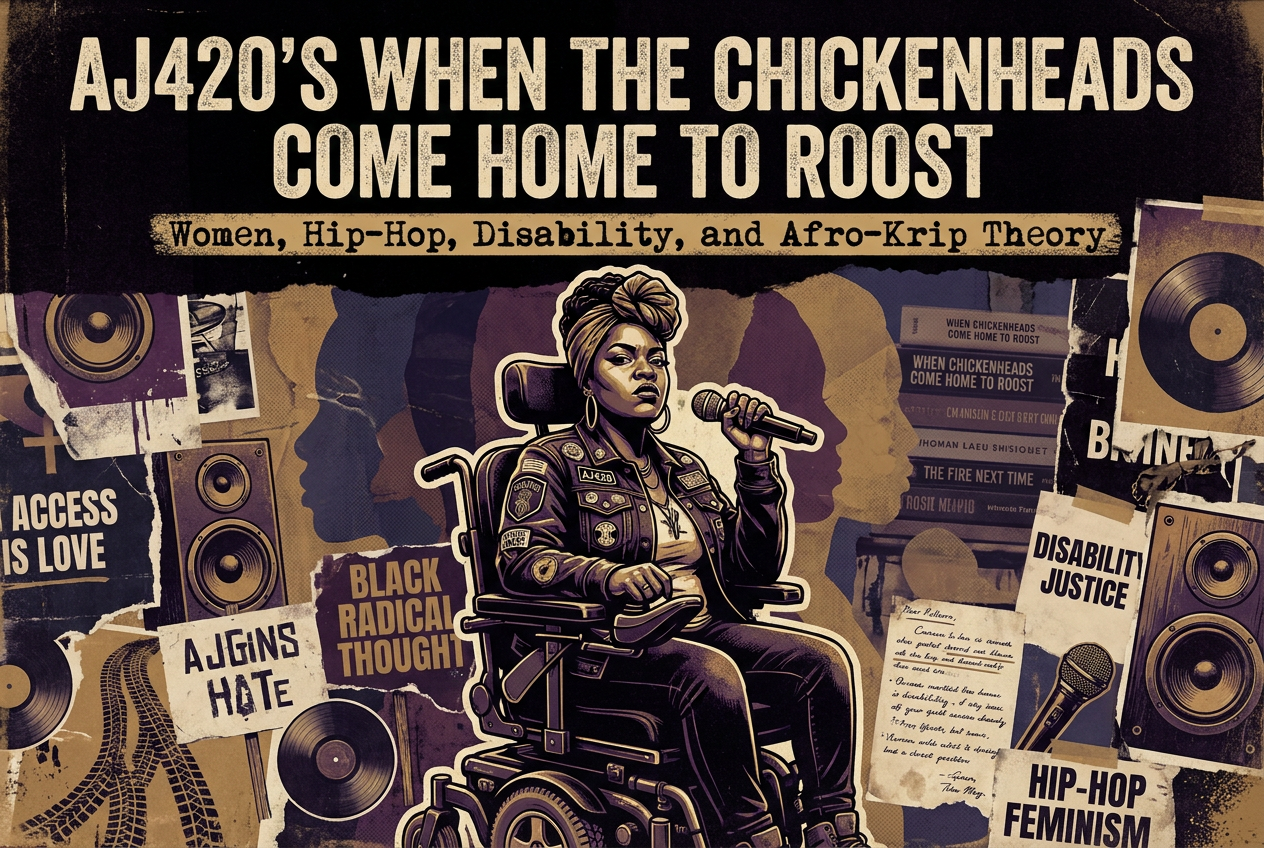
Disabled Women in Hip-Hop Theory (AJ420, Ashana Jha)
Women Hip-Hop scholars have not always centered disability explicitly, but their work provides critical conceptual tools especially around embodiment, vulnerability, care, and contradiction that Krip-Hop Nation extends into a fully articulated Afro-Krip framework. When read through disability, their insights reveal that the body has always been central to Hip-Hop’s politics; Krip-Hop makes that centrality explicit.
Tricia Rose offers one of the earliest frameworks for understanding Hip-Hop as grounded in lived, embodied conditions. In Black Noise, she writes that rap music “describes and analyzes the social conditions of Black urban life” (Rose 1994, 2). While Rose does not explicitly theorize disability, her insistence that Hip-Hop encodes structural violence provides a crucial opening. Krip-Hop extends this claim by arguing that those “social conditions” are not only narrated but inscribed on the body, particularly through injury, illness, and chronic debilitation. In this sense, Krip-Hop reframes Rose’s insight into an embodied analytic: Hip-Hop does not just describe oppression; it is performed through bodies shaped by it.
Similarly, Imani Perry positions rappers as intellectuals who theorize identity through performance. She argues that Hip-Hop is “a space where Blackness is continually constructed, contested, and performed” (Perry 2004, 10). Krip-Hop builds on this by insisting that disability is part of that construction of Blackness, not external to it. If identity is performed, then disabled embodiment through altered rhythm, breath, or technological mediation becomes a form of theory. Krip-Hop thus extends Perry’s framework by showing that performance is not only expressive but structured by bodily difference, making disability a constitutive element of Hip-Hop’s intellectual practice.
The intervention of Joan Morgan is especially important for Krip-Hop because of her emphasis on contradiction and what she calls the “messiness” of lived experience. In When Chickenheads Come Home to Roost, Morgan writes, “We need a feminism brave enough to fuck with the grays” (Morgan 1999, 59). This willingness to inhabit contradiction becomes foundational for Krip-Hop. Disability, particularly within Black communities, is often caught in tensions between strength and vulnerability, independence and interdependence.
This framework becomes even more materially grounded when read alongside Ashana Jha (AJ420)’s Krip-Hop intervention, “When the Chickenheads Come Home to Roost.” Building on Morgan’s Black feminist provocation, AJ420 reworks the “chickenhead” figure through an Afro-Krip lens, exposing how misogyny, ableism, and racialized desirability politics converge on disabled, queer, and gender-nonconforming bodies. Rather than rejecting the term outright, AJ420 inhabits and cripps it turning stigma into a site of critique and performance. In doing so, AJ420 demonstrates precisely what Morgan calls for: an engagement with contradiction that does not resolve tension but dwells within it.
Through AJ420’s lens, the “chickenhead” is no longer just a figure of misogynistic dismissal; it becomes an analytic for understanding how disabled bodies are read as excessive, unintelligible, or disposable within both Hip-Hop culture and broader society. Krip-Hop extends Morgan’s “gray space” into what might be called a cripistemological zone where desirability and disgust, visibility and erasure, agency and objectification are constantly negotiated. AJ420’s work shows that disabled embodiment intensifies these contradictions, making them unavoidable rather than peripheral.
Bettina L. Love further contributes to this conversation through her work on abolitionist teaching. Love argues that “we don’t just want to survive; we want to matter” (Love 2019, 3). While not explicitly about disability, this statement resonates deeply with Krip-Hop’s critique of survival as an insufficient framework. Disabled people, particularly Black disabled people, are often positioned within discourses of mere survival. Krip-Hop extends Love’s argument by asserting that disabled existence is not only about survival but about creativity, visibility, and epistemological authority. AJ420’s performances embody this shift: they refuse the reduction of disabled life to endurance alone and instead foreground pleasure, disruption, and presence as forms of mattering.
In a related vein, Joan Morgan and other Hip-Hop feminists foreground the body as a contested site shaped by power, pleasure, and pain. Although disability is often implicit rather than explicit in these discussions, Krip-Hop reads this emphasis on the body through an Afro-Krip lens. The body is not only gendered and racialized but also disabled, impaired, and adaptive. AJ420’s work makes this explicit by staging the disabled body as simultaneously hyper-visible and misread, challenging audiences to confront their own interpretive frameworks.
Krip-Hop also finds alignment with Alison Kafer, who, while not a Hip-Hop scholar, offers a framework widely used by feminist and cultural theorists. Kafer writes that “crip time…flexes to meet disabled bodies and minds” (Kafer 2013, 27). This concept becomes crucial in Krip-Hop performance, where timing, pacing, and rhythm are reconfigured. AJ420’s performances, in particular, embody crip time through non-linear delivery, pauses, and shifts that disrupt normative expectations of flow. These temporal disruptions are not deficits but methodologies forcing audiences to recalibrate how they listen, interpret, and value expression.
Krip-Hop Nation operationalizes these feminist insights in practice, particularly in spaces like GenderKrip Planet event. At GenderKrip Planet event disabled women, queer, and trans artists reshape Hip-Hop performance by centering bodies that do not conform to dominant norms. Artists such as Ashana Jha (AJ420) embody this intersection, bringing together disability, gender nonconformity, and diasporic identity. In these performances, feminist commitments to voice and agency are expanded through assistive technology, altered vocalization, and non-linear rhythm, demonstrating that communication exceeds speech.
Transcript of the event, GenderKrip Planet featuring Krip Hop artist, AJ420
….give it up for AJ yeah AJ 420
AJ420. “ I don’t ever need a plan B you’ll see shitting in my rid smoken weed hop the industry don’t kill me kill me cause i know it’s what i was mean to be what I was meant to be my name is AJ 420 I am a female rapper and I have cerebral palsy my flows something you can’t learn mom I’m in the lane swerve like the tonight is basically about like female artists with disabilities expressing themselves bringing different points of views to music and poetry.”
Lisa: “we’re here to celebrate a show calledgender planet and it’s a celebration of women Femmes and warriors so it’s like non-binary folks women celebrating our our artwork and there’s a record that came out today it’s called hell y’all ain’t alma a hop anthology this CD really covers the ground that leroy invited us to do….”
Tiny: I know we can get down behind a lot of the race and class consciousness that comes into hip-hop movement but there’s this disconnect when it comes to ableism and ableism or disability justice today is it’s just a continuation of the krip hop movement”
Through these interventions, Krip-Hop Nation extends women Hip-Hop scholars’ work in three critical ways. First, it makes explicit what is often implicit: that the body long central to Hip-Hop feminism is also a disabled body shaped by structural forces. Second, it expands feminist attention to contradiction into a theory of disabled embodiment, where vulnerability and strength coexist as productive tensions—what AJ420’s work frames as inhabiting and transforming stigma. Third, it transforms pedagogical insights about voice and agency into a multimodal framework, where communication includes silence, delay, technological mediation, and reinterpretation of harmful cultural symbols.”
Ultimately, women Hip-Hop scholars provide the conceptual groundwork for Krip-Hop, even when disability is not their explicit focus. By centering embodiment, lived experience, and contradiction, they open the door for Krip-Hop to argue that disability is not an add-on to Hip-Hop Studies but a necessary lens for understanding how knowledge, culture, and resistance are produced. My article entitled “AJ420’s When the Chickenheads Come Home to Roost” makes this intervention unmistakable: Afro-Krip knowledge emerges precisely in the spaces where feminism, disability, and Hip-Hop collide—and refuse resolution.
My song for the late AJ420, Ashana Jha