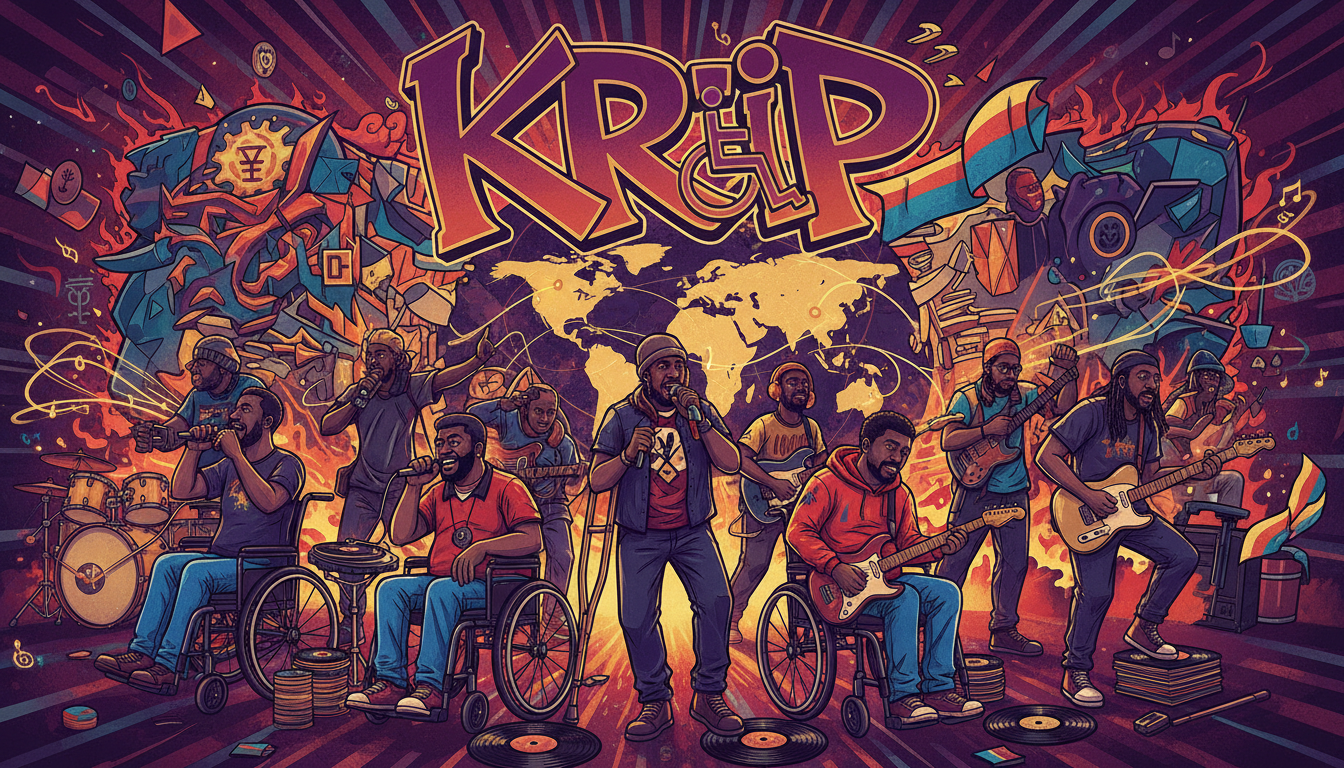
Ethnomusicology of Krip-Hop Nation
Krip-Hop Nation is a global network of artists with disabilities that intersects directly with ethnomusicology, the study of music in its social and cultural contexts. Founded in 2005 by Leroy F. Moore Jr., the movement uses Hip-Hop as a framework for disability advocacy, education, and cultural expression. From an ethnomusicological perspective, Krip-Hop Nation is significant for its examination of music as a social process used to navigate and challenge marginalization.
Culturally, the movement defines a distinct Krip-Hop culture that bridges racial and disability identities, particularly for Black disabled artists. It also reclaims derogatory language by transforming “Crip” into “Krip,” shifting the narrative from pity to empowerment. Academically, Leroy F. Moore Jr. has brought Krip-Hop into universities, completing a Master’s thesis on Krip-Hop Pedagogy and pursuing doctoral work at UCLA in linguistic anthropology and ethnomusicology.
Krip-Hop Nation serves as an activist platform for over 300 artists worldwide. Its work includes advocacy on issues like police brutality against disabled people and ableism in the music industry, building global networks with collaborators in Germany, the UK, and African nations such as Zimbabwe and South Africa, planning the Krip-Hop Institute to institutionalize Krip-Hop studies and pedagogy for marginalized Black disabled and other disabled artists, and producing mixtapes, CDs, and documentaries like Where is Hope to demonstrate the marketability and talent of disabled musicians.
Krip-Hop artists follow core cultural and political standards often referred to as the Seven Standards. These include using lyrics for social advocacy and teaching, challenging mainstream media’s framing of disability, honoring disabled ancestors in music history, and avoiding lyrics that put down other marginalized groups.
Krip-Hop is grounded in decolonizing and Disability Justice, examining how Blackness, disability, and hip-hop overlap to produce specific experiences of discrimination and resistance. It treats disability culture as a serious source of creative expression and political power, not just a limitation. The movement educates audiences, scholars, and media about disabled artists’ contributions and pushes for equal opportunities and representation.
A central aim is decolonizing thought and practice by integrating Black Disability Studies into Black communities and educational spaces. Krip-Hop uses hip-hop to challenge Black ableism, colonialism, and racism, reclaiming disability as a cultural identity and centering Black disabled voices in history and art to build political power and community. It blends Disability Studies, Black Studies, and Hip-Hop Studies to decolonize minds and reclaim narratives, redefining disability as a source of strength and resistance while advocating for self-representation, culturally relevant education, and solidarity through music and activism.
Key figures include founder Leroy F. Moore Jr.—author, poet, activist—and the late Rob Temple, an important co-founder in the early development of the movement. Krip-Hop’s projects span music, books, films, lectures, visual art, and festivals. Ethnomusicologically, it introduces new terminology and theoretical frameworks such as “Afro-Krip” to understand Black disability culture within music, builds global community among marginalized artists, and offers fresh cultural analysis of hip-hop’s history and politics through the lens of disability, challenging dominant narratives in music studies.