Krip Shaft: Reclaiming Black Disabled Masculinity Through Krip-Hop Politics
In 2025, I reimagined Isaac Hayes’ legendary 1971 anthem “Shaft” into “Krip Shaft.” This was never meant to be a parody. It is a political intervention grounded in Krip-Hop Nation’s mission of placing Black disabled people at the center of Black cultural production, liberation, and imagination. By kripping one of the most recognizable symbols of Black masculinity from the Blaxploitation era, I ask a simple but revolutionary question: What would Black empowerment look like if Black disabled men had always been included?
The original Shaft celebrated a fearless Black hero who moved through the city with confidence, intelligence, style, and charisma. During the early 1970s, films such as Shaft, Sweet Sweetback’s Baadasssss Song, Super Fly, and later Foxy Brown challenged Hollywood’s racist portrayals by presenting Black people as central heroes. Their soundtracks by Isaac Hayes, Curtis Mayfield, James Brown, and others became anthems of Black pride during the post-Civil Rights and Black Power era. Yet even as these films expanded representations of Blackness, disabled Black people remained absent. Krip Shaft begins by filling that gap.
My lyrics introduce a new cultural figure:
Who’s the Black public Krip
that’s a forbidden sex machine to all the chicks?
You damn skippy.
These opening lines intentionally echo Isaac Hayes while shifting the politics. The phrase “forbidden sex machine” confronts the myth that disabled people, especially disabled Black men, are undesirable, asexual, or incapable of intimacy. Krip Shaft rejects those stereotypes. He is desired, confident, and unapologetically present.
The song continues:
Who is the Krip that runs with a limp to save his brother Krip?
You dig it.
Here disability is not erased or overcome. The limp remains visible, but it does not diminish his power. Krip Shaft does not become heroic by pretending to be nondisabled; his disability is part of his strength. Whether walking with a limp or riding a scooter, he shows up when Black disabled people need one another.
Later, the lyrics declare:
Who’s the Black super Krip that pulls up when people are shouting?
Wheel on, Wheel on, Wheel on,
because this is only the beginning.
The repeated phrase “Wheel on” transforms wheelchair movement into an anthem of liberation. Wheels become symbols of political motion rather than confinement. Disability technologies are not limitations but vehicles carrying Black freedom forward. This is Krip-Hop politics in motion.
Another key line states:
He is the invisible man.
But no one can see him but his woman.
Black disabled men are often erased within conversations about Black masculinity and within disability culture dominated by whiteness. This lyric confronts that erasure directly. Krip Shaft refuses to remain hidden, and his visibility is rooted in love, desire, and recognition rather than domination.
The song concludes:
Brother to brother,
Sister to sister,
Hand in hand,
Krip Shaft you understand.
Unlike many action heroes whose stories celebrate individualism, Krip Shaft represents collective survival. Solidarity replaces competition, and disability justice becomes inseparable from Black liberation.
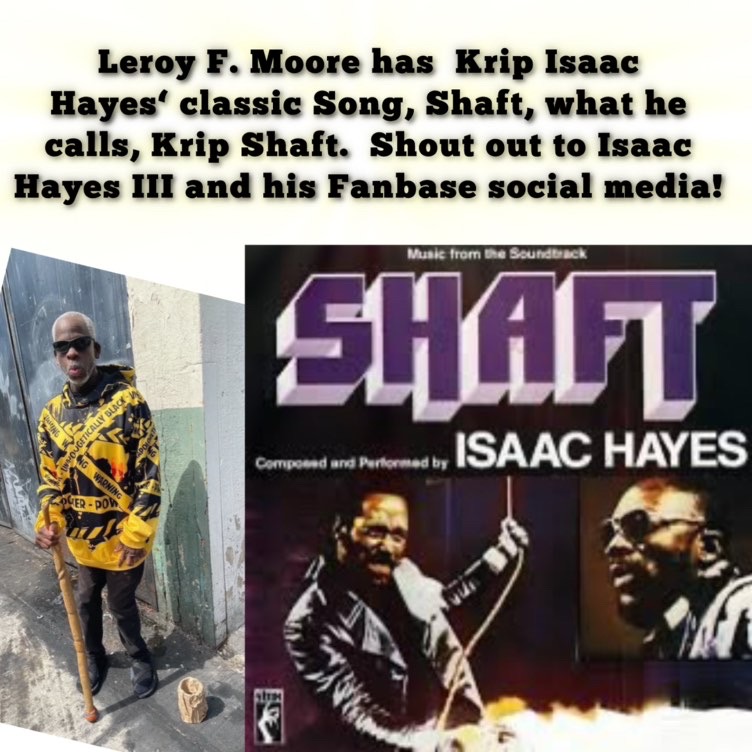
The visual image accompanying the project strengthens this political message. Isaac Hayes’ original Shaft cover portrays him in black leather gloves and jacket, pulling on a rope with unmistakable confidence. My promotional image places me beside that legacy wearing black sunglasses, a yellow-and-black hoodie, and holding my solid wooden cane. The cane is not hidden. It is neither medical equipment nor a symbol of weakness. Like Hayes’ leather gloves, it became part of the iconography of Black power.
The remake also pays tribute to Isaac Hayes while bringing his legacy into the digital age:
R.I.P. Isaac Hayes
Communicating on Fanbase.
This lyric honors Hayes’ influence while giving a shout-out to Isaac Hayes III and the Fanbase social media platform, connecting generations of Black cultural innovation.
Krip Shaft also builds upon my decades of musical activism through Krip-Hop Nation. For years I have rewritten classic songs to center Black disabled life. Working alongside the late Rob Da Noize Temple, I transformed Curtis Mayfield’s “Beautiful Brother of Mine” into an anthem encouraging Black disabled men to hold their heads high. Together we also created “Man to Man Talk” and “Black Disabled Man,” placing Black disabled masculinity at the center of Hip-Hop. I later kripped Josh White Sr.’s “The Blind Man Stood on the Road and Cried,” reclaiming another historical Black musical narrative through disability politics. Krip Shaft continues that tradition.
What makes this remake unique is that it inserts Black disabled men into one of the most iconic symbols of Black cinematic masculinity. Rather than asking for inclusion within existing representations, Krip-Hop Nation creates entirely new ones. Krip Shaft is not waiting to be rescued. He is the protector, the lover, the organizer, and the revolutionary.
This vision extends beyond the Blaxploitation era into the present. Contemporary Black heroes, from Luke Cage whose story also incorporates disability and recovery through his partner’s bionic arm to today’s Black disabled artists and activists, remind us that power can take many forms. Krip-Hop expands these possibilities by insisting that disability belongs within every conversation about Black freedom.
Ultimately, Krip Shaft is about image making. For too long, Black disabled men have been portrayed through charity, tragedy, or silence. Krip-Hop Nation rejects all three. Instead, we create our own heroes, our own soundtracks, and our own political imagination.
Krip Shaft wheels through the city with pride. He protects his people. He challenges ableism inside and outside the Black community. He reclaims desire, strength, vulnerability, and love as part of Black disabled life.
By kripping Isaac Hayes’ Shaft, I am not rewriting history. I am completing it.
Black liberation has always included disabled people.
Now the soundtrack finally says so.
Krip Shaft ( Leroy F. Moore has Krip Isaac Hayes‘ classic Song, Shaft). R.I.P.