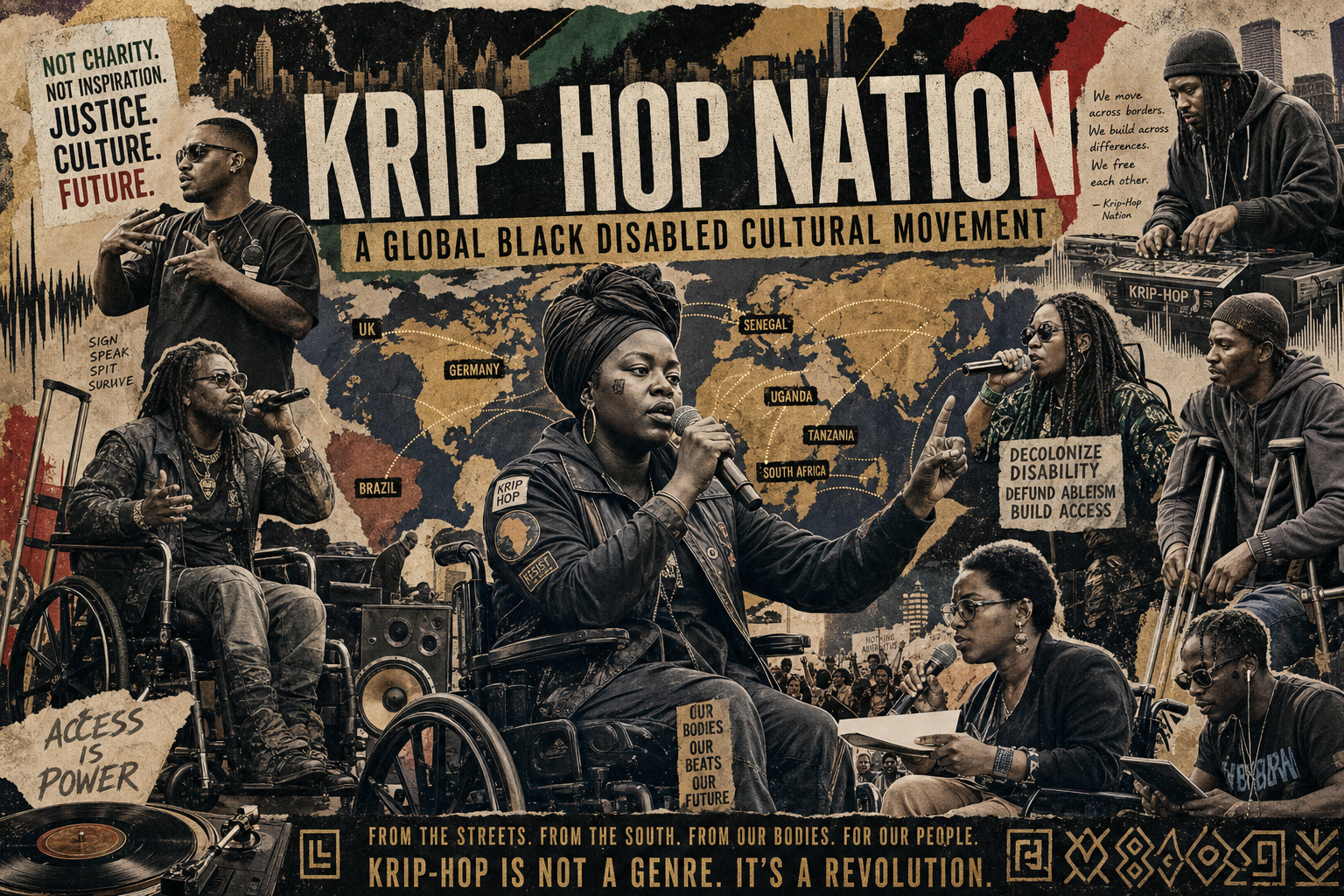
Krip-Hop Nation’s International Work: Building a Global Black Disabled Cultural Movement
Krip-Hop Nation began as a movement to center disabled Hip-Hop artists, but over the last two decades it has grown into an international cultural, political, and educational network connecting Black disabled artists, scholars, organizers, and communities across Africa, Europe, Latin America, and beyond. Founded by Leroy F. Moore in Berkeley, California, Krip-Hop Nation was never limited to the United States. From the beginning, the project challenged the idea that disability culture and Hip-Hop culture were separate. Instead, Krip-Hop positioned disability as part of the global history of Black music, resistance, migration, and survival.
Internationally, Krip-Hop Nation operates as a worldwide association of disabled artists who use music, poetry, performance, education, and activism to confront ableism, racism, colonialism, and poverty. The movement has developed chapters and collaborations in countries including South Africa, Zimbabwe, Tanzania, Germany, Brazil, Spain, Uganda, and the United Kingdom. Rather than exporting an American model of disability politics, Krip-Hop creates local partnerships where disabled artists connect Hip-Hop to their own political realities—whether that involves anti-Black racism in Brazil, post-apartheid inequality in South Africa, or the exclusion of disabled artists from European arts institutions.
One of Krip-Hop Nation’s strongest international connections has been with Africa, especially South Africa. Krip-Hop has worked with disabled artists, organizers, and cultural workers there to build what Moore describes as “Krip-Hop chapters in Africa.” These collaborations connect Black disability politics to broader struggles around land, colonialism, police violence, education, and economic exclusion. Krip-Hop’s work in South Africa is especially significant because it links Black disability studies with post-apartheid cultural production. The movement has organized performances, lectures, workshops, and plans for a Krip-Hop theatrical production to tour South Africa.
Krip-Hop’s relationship with Africa also reflects a deeper intellectual and political commitment to Pan-Africanism and the Black Radical Tradition. Moore has repeatedly argued that disabled Black people have always existed within Black liberation movements, even if they were erased from official histories. Through international lectures and conferences, including presentations in Senegal and at the University of Cape Town, Krip-Hop frames disability not as an isolated medical condition but as part of global systems of racial capitalism and colonial violence.
In Europe, Krip-Hop Nation has built major relationships with disability arts networks and Hip-Hop artists in Germany and the United Kingdom. Disabled MCs and performers from Germany became part of Krip-Hop festivals and touring performances, helping create transnational conversations around disability culture and underground Hip-Hop. Krip-Hop also performed in Liverpool through disability arts spaces connected to Deaf and Disability Arts movements. These performances demonstrated that disability arts did not have to remain confined to theater or institutional spaces; Hip-Hop itself could become disability culture.
The movement’s work in Brazil is equally important because it connects Black disability politics across the African diaspora. Krip-Hop has collaborated with Black disabled Brazilians and planned presentations connected to discuss Afro-Brazilian disability movements and artistic resistance. These collaborations extend Krip-Hop’s concept of “Afro-Krip” identity internationally by showing how anti-Blackness and ableism intersect globally while taking different forms in different national contexts.
Krip-Hop Nation also internationalized disability justice through media production. The movement released mixtapes and collaborative music projects featuring disabled artists from the United States, Germany, and the United Kingdom focused on issues like police brutality, profiling, and state violence. These projects treated music as political education, documenting how disabled people—especially Black disabled people—experience criminalization worldwide. Krip-Hop’s music therefore functions not simply as entertainment but as transnational testimony.
Another important aspect of Krip-Hop’s international work is education. Through lectures, conferences, universities, documentaries, and workshops, Krip-Hop has brought Black disability politics into academic spaces around the world. Moore’s work in ethnomusicology and linguistic anthropology positions Krip-Hop as both a cultural movement and an intellectual intervention into Disability Studies, Hip-Hop Studies, and Black Studies. Krip-Hop argues that disabled artists are not merely subjects to be studied; they are theorists producing knowledge through sound, poetry, and performance.
The international reach of Krip-Hop Nation is ultimately about building a global disabled cultural front rooted in Blackness, decolonization, and collective survival. It refuses the charity model often attached to disability and instead centers disabled people as creators of culture, theory, and political struggle. Through chapters, tours, festivals, lectures, films, and collaborations, Krip-Hop Nation has transformed from a local Hip-Hop intervention into an international movement linking Black disability politics across continents. In doing so, it has created one of the first truly global networks dedicated to disabled Hip-Hop artists and Black disabled cultural production.