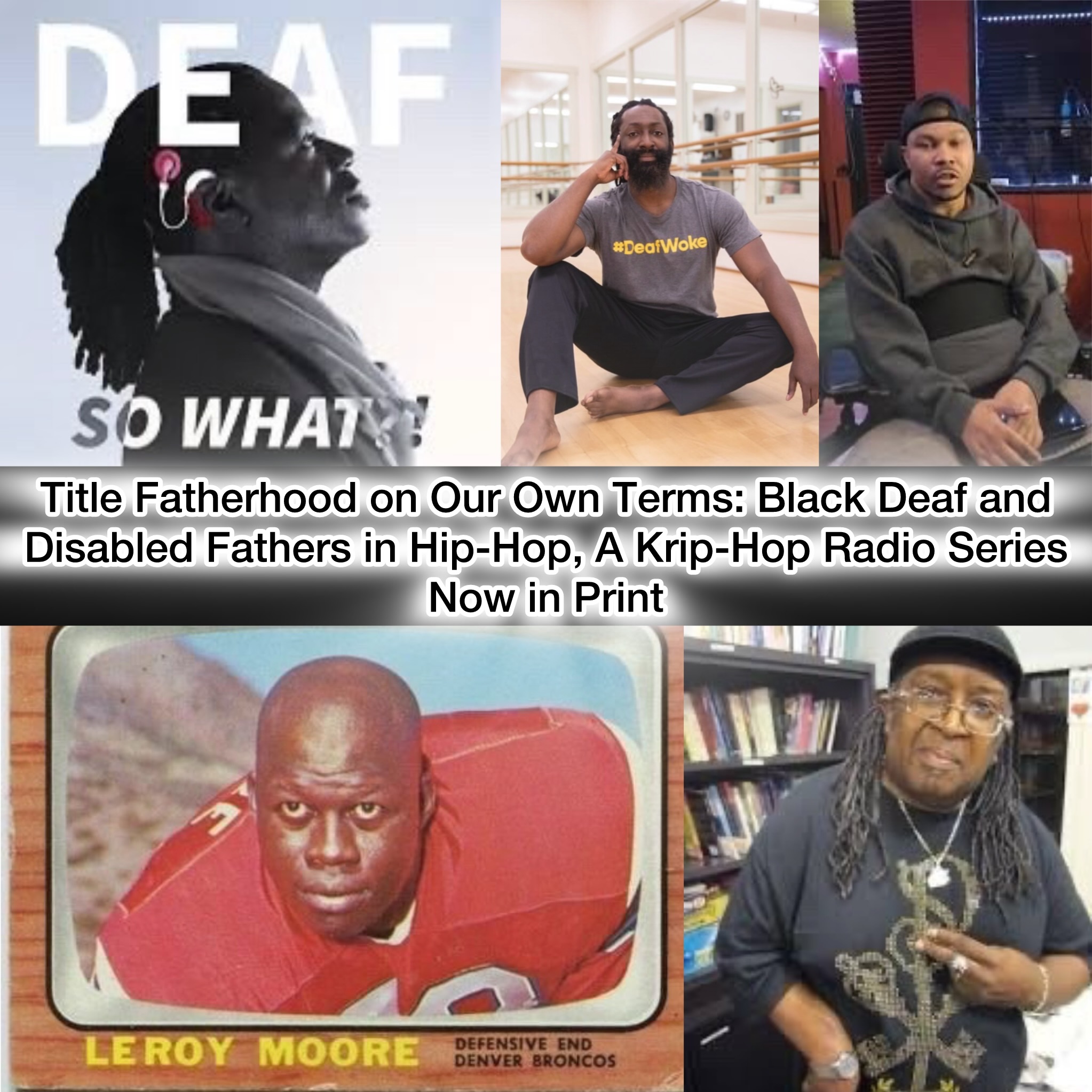
For three years 2012, 2019, and 2020 Krip-Hop Nation used Father’s Day as more than a holiday celebration. Through radio broadcasts on Poor Magazine, print interviews, music, and community storytelling, Krip-Hop Nation created a space where Black Deaf and disabled fathers could speak for themselves. Krip-Hop Nation challenged the charity-based narratives often attached to disability and instead centered the lived realities of fatherhood, artistry, advocacy, and survival.
These Father’s Day specials featured artists and activists such as Rob Da’ Noize Temple, Lee Williams, King Kaution, Cool V, Warren Snipe (WAWA), Antoine Hunter, and Timotheus Gordon Jr. Through interviews, songs, and personal testimonies, they collectively painted a picture of Black disabled fatherhood that is rarely represented in mainstream media. These are only some transcripts of the series interviews.
The 2019 Father’s Day Special aired on Poor News Network, PNN, KEXU 96.1 FM in Oakland and featured music such as Warren Snipe’s powerful reflections on Deaf family experiences, Rob Da’ Noize Temple’s collaborations, and my own song, “Football Father & Kripple Son.” In 2020, Krip-Hop Nation focused specifically on Black Deaf fathers, highlighting Deaf hip-hop artist and actor Warren Snipe from Washington, D.C., and Oakland-based Deaf dancer and poet Antoine Hunter. These programs demonstrated that disability, Deafness, parenthood, and Black identity are not separate experiences but interconnected realities.
 One important artist connected to these conversations is Deaf Black rapper Warren “WAWA” Snipe. Known internationally for blending American Sign Language, hip-hop, and performance, WAWA has consistently used music to challenge stereotypes about Deaf people and expand access within hip-hop culture. His work highlights Deaf experiences while affirming Black identity, creativity, and community. He is also known as the father of Dip-Hop, Deaf Hip-Hop.
Among his notable works is the song and music video “Faceless Man.” The video explores themes of struggle between a Deaf Black boy and his father who can’t and won’t relate to his son’s deafness. His mother dropped him off at his father’s but his father refuse to understand him and left him on the porch waiting for his mother to pick him up. Through expressive signing, visual storytelling, and hip-hop performance, WAWA conveys the emotional impact of being ignored or misunderstood while also asserting resilience and self-determination.
“Faceless Man” stands as a powerful artistic statement about Black Deaf son and their relationship with a father who refuse to learn about his son Deaf culture and what Leroy calls displaying Black ableism to his own son, the feeling of being unseen and overlooked, particularly from the perspective of a Deaf person navigating a hearing-centered world. Through visual storytelling, expressive signing, and hip-hop performance, WAWA portrays the frustration of being ignored, misunderstood, or treated as invisible. At the same time, the video is a statement of empowerment, rejecting erasure and demanding recognition, respect, and inclusion. “Faceless Man” ultimately explores identity, visibility, and the human need to be acknowledged as a full and valued member of society.
One of the strongest themes throughout the interviews was visibility. Rob Da’ Noize Temple recalled taking his children to playgrounds and public spaces where people would stop and stare. As a father with one arm, he worried less about himself than about how his children would be treated. Yet he emphasized that his mother had taught him independence early in life, showing him how to cook, clean, and care for family members with one hand. Because of that foundation, he said, his children lived what he considered a normal life.
King Kaution shared similar experiences. As a Black disabled father, he often found himself answering questions from curious children in public. Yet rather than seeing this attention as entirely negative, he noted that many people congratulated him for remaining actively involved in his children’s lives. His presence challenged assumptions that disabled men or Black fathers are somehow incapable of parenting.
Lee Williams approached public encounters differently. He spoke about the power of greeting people with a smile. Since becoming disabled in 1980, he found that warmth often helped break down people’s discomfort and misconceptions. For Williams, his children, grandchildren, great-grandchildren, and great-great-grandchildren continuously reminded him of life’s joys and kept him connected to community.
Another important voice featured in Krip-Hop Nation’s Father’s Day programming was Oakland-based Deaf dancer, choreographer, and activist Antoine Hunter. Hunter’s reflections centered on Black Deaf identity, fatherhood, resilience, culture, and responsibility during a period marked by both the COVID-19 pandemic and heightened awareness of police violence against Black communities.
Hunter spoke proudly about being both Black and Deaf, explaining that he rarely saw representations of Black Deaf people while growing up. As a result, he was forced to define that identity for himself. Through that process, he developed a strong sense of self grounded in Black culture, Deaf culture, and a commitment to humanity. This self-understanding, he explained, provided the strength needed to navigate both racial injustice and the uncertainties of the pandemic.
As a father, Hunter described helping his child understand the challenges of COVID-19. When his child expressed frustration about restrictions on play and social interaction, Hunter focused on teaching lessons about protection, care, and love rather than fear. He emphasized that people could learn new ways to stay safe while continuing to care for one another and remain connected to their communities.
Fatherhood also transformed Hunter’s artistic practice. As a professional dancer and founder of the Bay Area International Deaf Dance Festival, he found inspiration in his child’s movements, behaviors, and curiosity. Everyday interactions became sources of creative exploration. More significantly, becoming a parent changed how he approached his work as an artist. He began asking whether the messages contained in his performances would be meaningful and understandable to his child, deepening his commitment to creating socially conscious art.
Hunter also discussed raising a hearing child within both Deaf and hearing communities. This experience gave him unique insight into accessibility, inclusion, and cultural exchange. It reinforced his belief that artistic and community spaces should welcome Deaf and hearing participants alike, creating opportunities for shared understanding and collaboration.
One of the most moving moments in the interview came when Hunter reflected on his own father. Because his father was largely absent during his childhood, Hunter understood firsthand the impact that absence can have on a child’s life. Rather than repeating that pattern, he used those experiences as motivation to remain fully present for his own child. Despite the demands of an international career, he continually worked to balance artistic responsibilities with fatherhood.
Hunter also challenged scholars and researchers to pay greater attention to Black Deaf parents and disabled Black families. He noted the lack of research, resources, and public discussion surrounding these experiences and recalled feeling isolated when he first became a father. His message was clear: the stories of Black Deaf and disabled mothers and fathers deserve documentation, study, and recognition.
For Hunter, fatherhood means complete commitment. He described the parent-child bond as an extension of oneself, arguing that caring for one’s own well-being is also a way of caring for one’s child. He emphasized sacrifice, responsibility, and unconditional love. In closing, he drew a distinction between simply being a biological father and being a true parent. Anyone can become a father, he explained, but being a real “Daddy” or “Baba” requires daily investment, presence, patience, and love. Perfection is impossible, but parents must continue learning, growing, and giving their best effort every day.
Hunter’s testimony reinforced many of the themes that emerged throughout Krip-Hop Nation’s Father’s Day Specials: Black Deaf pride, resilience in the face of injustice, the transformative power of fatherhood, and the importance of community responsibility. His story demonstrated that fatherhood is not defined by perfection but by commitment, love, and the willingness to show up every day for one’s child.
The interviews also revealed that fatherhood extends beyond biological relationships. Cool V discussed raising his sister’s children after family circumstances made it necessary. One of the children is autistic, and Cool V described how caregiving transformed his life. He rejected limiting ideas about disability and instead emphasized the child’s intelligence, compassion, and determination. Raising his nephews taught him patience, forgiveness, and responsibility while also requiring sacrifices in his entertainment career. His story expanded the meaning of fatherhood to include kinship care, community responsibility, and chosen family.
Throughout the interviews, the fathers repeatedly emphasized legacy. Rob Da’ Noize Temple, a musician and member of the extended Sugarhill Gang family, spoke openly about balancing corporate work, music, disability, and parenting. He described raising five children and reflected on the loss of his son Anthony, who died from complications related to sickle cell anemia. His song “Antonio’s Song” became both a memorial and an expression of grief. For Rob, music was always connected to family. He hoped his work would leave a legacy that his children could be proud of, even while acknowledging the sacrifices and missed moments that came with pursuing a music career.
King Kaution similarly viewed his children as his motivation. He spoke about teaching them technology, music, and life lessons. His sons assisted him with everyday activities, from helping him dress to supporting his recording sessions. Through these interactions, disability became part of family culture rather than an obstacle to family life.
The fathers also challenged dominant ideas about Black masculinity. Rob Da’ Noize Temple argued that disability and masculinity are often incorrectly linked through stereotypes. He maintained that his masculinity was never in question; rather, the barriers he encountered came from discrimination, exclusion, and industry politics. He rejected the idea that fatherhood is measured by physical strength, appearance, or social status. Instead, he asked deeper questions: Will you be there? Will you sacrifice? Will you remain committed to your family?
Cool V echoed this sentiment, criticizing societal narratives that reduce Black fatherhood to absenteeism and failure. He argued that communities often spend more time focusing on negative stories than supporting men who are actively caring for children. Likewise, King Kaution pointed out that disabled men deserve the opportunity to present themselves with pride and dignity rather than being viewed through medicalized stereotypes.
Another powerful thread throughout the interviews was intergenerational learning. Rob credited his mother for preparing him to navigate a world that offered little sympathy for disability. She taught him practical skills while instilling confidence and independence. Cool V reflected on growing up with a father who was largely absent and how that experience motivated him to become a better role model for the next generation. King Kaution spoke emotionally about his mother’s sacrifices following his accident, while Lee Williams described a father who, despite reconnecting later in life, expressed deep affection toward him and his children.
Music remained at the center of these conversations. For many of the fathers, artistic expression was inseparable from family life. Children attended performances, participated in recordings, and became part of artistic communities that included disabled musicians, activists, and organizers. Through Krip-Hop Nation, these families encountered disability not as a limitation but as a source of creativity, resilience, and cultural knowledge.
The Father’s Day Specials ultimately revealed a broader truth. Black Deaf/Disabled fathers have always existed, loved, created, struggled, and cared for their families, even when society refused to acknowledge them. Krip-Hop Nation’s contribution was not simply producing interviews or radio programs. It created an archive of voices that challenged ableism, racism, and narrow definitions of masculinity. These fathers demonstrated that parenting is not measured by physical ability, wealth, fame, or public recognition. It is measured by presence, sacrifice, love, and commitment.
As Rob Da’ Noize Temple advised, fathers should cherish every moment with their children and never take those moments for granted. King Kaution reminded fathers to stay involved, communicate openly, and show their children they care. Cool V called on communities to support fathers who are trying to do the right thing. Together, these messages form a collective testimony that Black Deaf/Disabled fatherhood is not an exception to be celebrated once a year. It is an essential part of Black family life, community building, and cultural survival.
Through these Father’s Day projects, Krip-Hop Nation preserved stories that are too often left untold. In doing so, it expanded the meaning of both fatherhood and disability while creating a living archive for future generations of Black Deaf and disabled boys, fathers, artists, and activists.