Tookie Gave Me Permission
It didn’t fall from the sky.
It wasn’t born in an academic archive.
I didn’t invent it.
And it didn’t start in Hip-Hop.
A Black newspaper in San Francisco liked my writing and published my articles on Black disability issues. Through that work, I began corresponding with disabled prisoners and documenting stories often ignored by both disability organizations and Black institutions. One of those stories involved Michael Manning, a disabled prisoner whose struggle for freedom and then I got in contact with activists at Freedom Archives.
One day they asked me: “Leroy, do you still want to send questions to Stanley ‘Tookie’ Williams?”
I only had room for two questions.
My first question was simple: “Is it true that the word Crip came from a disabled gang member?”
The second question will remain between me and the late Tookie Williams.
 In his reply, Tookie wrote: “I read the Bayview newspaper and I like your writing and organizing. If your organization was around in my day, a lot of Black young men who became physically disabled would have had a chance to not only be an activist but to be proud of disability with your help turning hopelessness and pity into Black disability empowerment. By the way, yes the Crips had a physically disabled member so we called him Crip for short so among the other stories of how we got our name, Crips, this is one of them.”
The significance of this exchange is not whether it definitively settles the historical origins of the Crips. Rather, it reveals something deeper: disability has always existed within Black urban life, Black street culture, and Black community formation. Long before disability studies theorized Crip as a political identity, Black communities were already negotiating disability, naming it, living with it, and creating meaning around it.
This article begins from that insight.
Abstract
This article theorizes the distinction between Crip and Krip as a critical intervention into disability studies, Black studies, Hip-Hop studies, and Black Disability Justice. While Crip has emerged as a reclaimed identity and analytic within disability studies, queer theory, and disability activism, it remains limited in its ability to account for the racialized, classed, and cultural dimensions of Black disabled life.
In response, this article advances Afro-Krip Theory, a framework that centers Blackness, disability, and poverty as co-constitutive forces shaped by racial capitalism, colonialism, and cultural production. Drawing upon the scholarship of John Langston Gwaltney, Frantz Fanon, Cedric Robinson, Christopher Bell, Nirmala Erevelles, Fred Moten, and the community knowledge traditions of POOR Magazine, this article argues that Black disabled people are not merely subjects of study but producers of theory.
Using Krip-Hop Nation as a case study, the article demonstrates how Black disabled artists create alternative archives, methodologies, and political visions through music, poetry, performance, and community organizing. Krip is therefore not simply a variation of Crip. It is a radical rearticulation of disability through Black cultural practice and a framework for understanding Black disabled life as a site of knowledge production, resistance, and liberation.
Introduction: Language, Power, and the Stakes of Naming
Language is never neutral. As Stuart Hall reminds us, language is a site of struggle where identities are continuously contested and produced.
The distinction between Crip and Krip reflects more than spelling. It reflects competing understandings of disability, race, culture, and power.
Within disability studies, Crip has emerged as a reclaimed identity challenging ableist assumptions and compulsory able-bodiedness. Robert McRuer argues that Crip theory disrupts normative assumptions about bodies, sexuality, and social value.
Yet, as Christopher M. Bell observed, disability studies has often functioned as a form of “white disability studies,” marginalizing the experiences of disabled people of color. Theories of disability that ignore race risk reproducing the very exclusions they claim to challenge.
The emergence of Krip through Krip-Hop Nation represents an attempt to address this absence. Krip insists that disability cannot be separated from Blackness, poverty, colonialism, state violence, or cultural production.
From Core Black Culture to Afro-Krip Theory
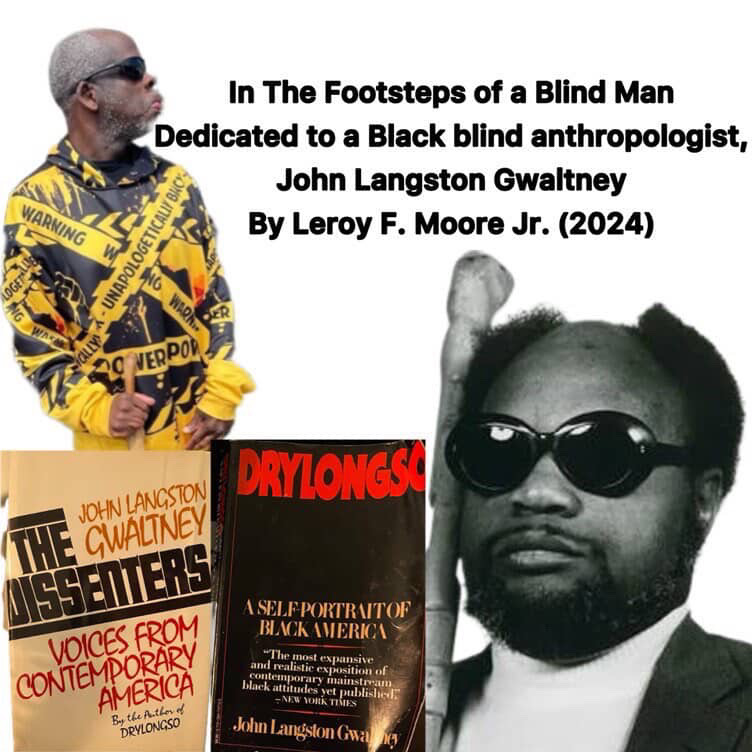
Afro-Krip Theory builds upon the work of John Langston Gwaltney, whose concept of “core Black culture” challenged the notion that poor Black communities were passive objects of study.
Gwaltney demonstrated that ordinary Black people possessed sophisticated analyses of their own social conditions. They were theorists, historians, and intellectuals in their own right.
Afro-Krip Theory extends Gwaltney’s insight by arguing that Black disabled people are likewise producers of knowledge. Black disabled people do not simply experience oppression; they interpret it, document it, challenge it, and theorize it.
Krip-Hop artists function as contemporary core Black ethnographers. Through music, poetry, interviews, archives, and community storytelling, they document forms of Black disabled life frequently erased from both academic scholarship and mainstream Black political discourse.
Afro-Krip Theory therefore begins with a simple proposition: Black disabled life is theory.
Crip Theory and Its Limits
Crip Theory has made important contributions to disability studies by exposing compulsory able-bodiedness and challenging dominant understandings of normality. However, several limitations emerge when Crip Theory is applied to Black communities.
First, race often remains secondary. Second, poverty frequently appears as context rather than structure. Third, colonialism and anti-Blackness are rarely central analytic categories.
As Nirmala Erevelles argues, disability is produced through material conditions including poverty, labor exploitation, war, incarceration, and state violence. For many Black communities, disability cannot be separated from these realities.
A Black disabled child navigating environmental racism, underfunded schools, police surveillance, and medical neglect experiences disability differently than frameworks centered primarily on identity politics often acknowledge.
Afro-Krip Theory emerges from this gap.
Decolonizing Disability: Fanon and Afro-Krip Theory
Afro-Krip Theory also draws upon the work of Frantz Fanon. Fanon argued that colonialism did not simply exploit land and labor. It reorganized humanity itself by creating hierarchies of value, productivity, intelligence, and bodily worth.
Within colonial systems, disabled bodies became associated with deficiency, dependency, and social death. Black disabled bodies experienced a double process of dehumanization—racialized and ableist.
From an Afro-Krip perspective, ableism is not merely prejudice against disabled people. It is part of a broader colonial project that ranks bodies according to their usefulness to racial capitalism.
Decolonizing disability therefore requires more than accessibility or representation. It requires dismantling colonial ideas about whose bodies matter.
Black Disability, Poverty, and Racial Capitalism
Afro-Krip Theory understands disability through the framework of racial capitalism developed by Cedric J. Robinson. Robinson argued that capitalism developed through racial hierarchies rather than apart from them.
Afro-Krip Theory extends this analysis by arguing that disability is likewise produced through racialized economic systems.
Poor housing produces illness. Environmental racism produces disability. Prisons produce disability. Police violence produces disability. War produces disability. Medical neglect produces disability.
The work of POOR Magazine further demonstrates that poverty itself operates as a disabling condition. From this perspective, poverty is not simply a consequence of disability. Poverty is a structure that actively produces disability while simultaneously limiting access to resources necessary for survival.
From Crip to Krip
The difference between Crip and Krip is not merely linguistic.
Crip primarily emerges from disability studies and queer theory. Krip emerges from Black cultural production.
Crip focuses on reclaiming disability. Krip focuses on transforming disability through collective Black struggle.
Crip critiques compulsory able-bodiedness. Krip critiques ableism, racism, poverty, colonialism, and state violence simultaneously.
Crip is often rooted in academic discourse. Krip is rooted in Hip-Hop, Blues, oral history, community archives, and grassroots organizing.
The “K” in Krip signals a Black cultural intervention into disability discourse. It reflects the linguistic creativity of Hip-Hop Nation Language while simultaneously marking a political shift toward Black Disability Justice.
Before Hip-Hop: A Longer Afro-Krip Tradition
Krip-Hop Nation did not emerge from nowhere. Black disabled cultural production predates Hip-Hop by centuries.
The histories of Blind Tom Wiggins, Blind Lemon Jefferson, Blind Willie Johnson, Reverend Gary Davis, Ray Charles, Stevie Wonder, and South African musician Babsy Mlangeni reveal long traditions of Black disabled artistic resistance.
These artists transformed disability into cultural expression while confronting racism, segregation, colonialism, and economic exclusion.
Afro-Krip Theory understands Krip-Hop Nation as part of this longer genealogy. Krip-Hop is not the beginning. It is the continuation of a Black disabled radical tradition.
Krip-Hop as Methodology
Krip-Hop Nation should not be understood solely as a movement or organization. It is also a methodology.
Through poetry, music, oral history, community archives, performance, and activism, Krip-Hop produces knowledge from below.
Traditional academic institutions often determine what counts as legitimate knowledge. Krip-Hop challenges that authority.
Lyrics become ethnography. Poetry becomes theory. Performance becomes critique. Archives become acts of resistance.
In this sense, Krip-Hop functions as a form of community-based knowledge production rooted in Black disabled experience.
Black Disabled Men and Afro-Krip Theory
Afro-Krip Theory also intersects with the work of Tommy J. Curry. Curry critiques theories that universalize oppression while obscuring the specific vulnerabilities of Black men.
For Black disabled men, criminalization, ableism, poverty, incarceration, and racial violence often operate simultaneously.
The experiences of disabled Black men within schools, prisons, psychiatric institutions, and police encounters reveal forms of oppression inadequately addressed by either mainstream disability studies or traditional Black political frameworks.
Afro-Krip Theory therefore insists that Black disabled men must be examined as a distinct site of inquiry within Black Disability Justice.
Krip-Hop Nation: Cultural Production as Praxis
Krip-Hop Nation represents the practical application of Afro-Krip Theory. As an international network of disabled artists and artists of color, Krip-Hop challenges both ableism and racism through cultural production.
Its performances create alternative spaces where disabled embodiment is neither hidden nor pitied. Wheelchairs become instruments of movement. Sign language becomes performance. Difference becomes artistic innovation.
Krip-Hop artists produce what Fred Moten describes as a form of Black radical critique through sound, movement, language, and collective creation.
Their work demonstrates that Black disabled communities are not merely resisting oppression. They are creating new worlds.
Conclusion
The movement from Crip to Krip represents more than a change in spelling. It marks a shift from disability reclamation toward Black disability liberation.
Afro-Krip Theory argues that disability must be understood through the interconnected realities of Blackness, poverty, colonialism, racial capitalism, and cultural production. Building upon the work of Gwaltney, Fanon, Robinson, Bell, Erevelles, Moten, Curry, and community-based traditions such as POOR Magazine, it positions Black disabled people as theorists, historians, artists, and knowledge producers.
If Afro-Krip Theory provides the analytic framework, then Krip-Hop represents its cultural and political practice. Through music, poetry, archives, organizing, and international solidarity, Krip-Hop transforms Black disabled experience into knowledge, resistance, and collective action.
In this sense, Krip-Hop is not simply an artistic movement. It is a Black Disability Justice tradition whose significance extends far beyond Hip-Hop itself. It is part of a long Black radical lineage that insists Black disabled lives are not only worthy of study, they are capable of producing theory, culture, and visions of liberation for the future.