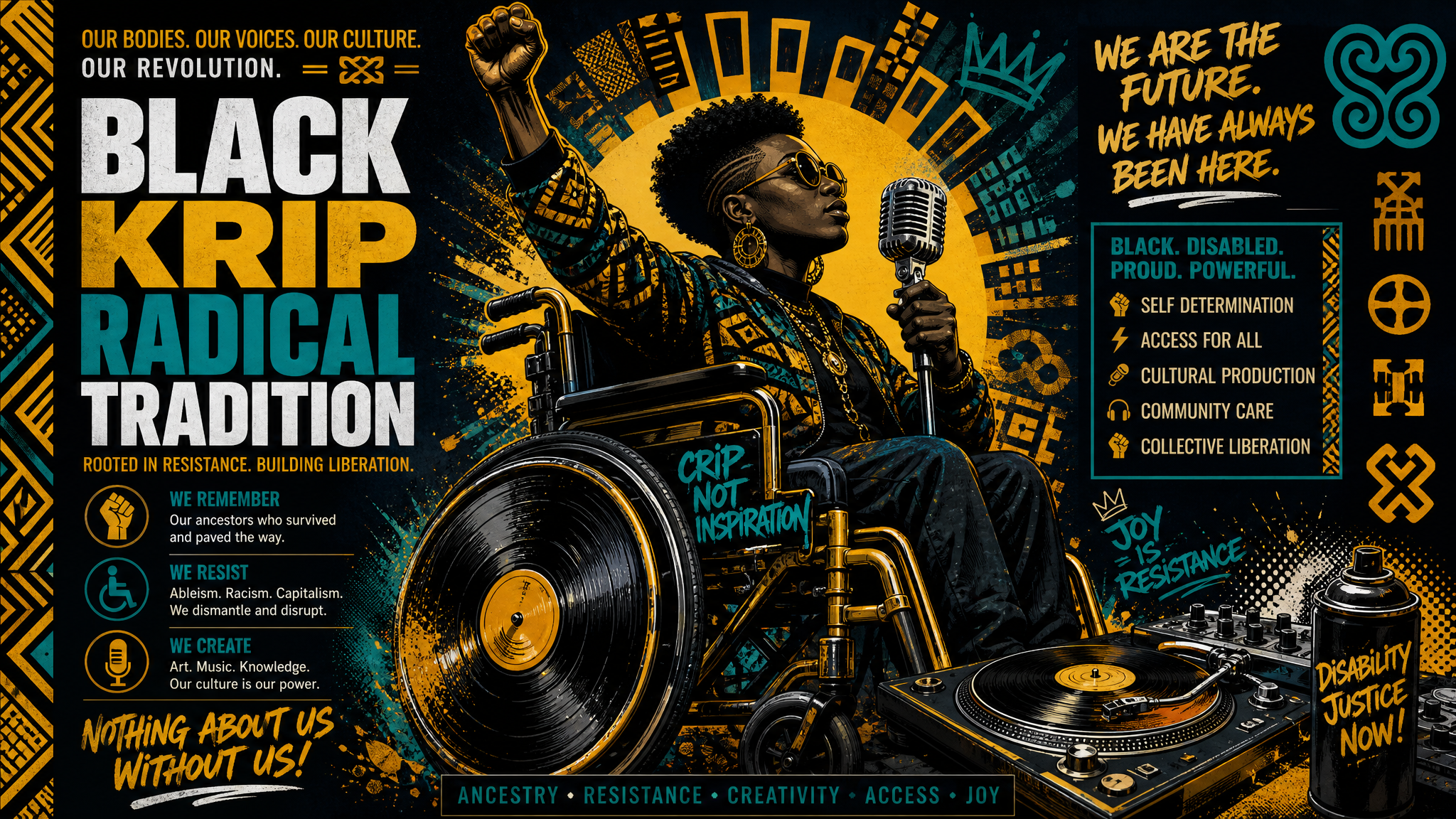
What Is The Black Krip Radical Tradition?
The Black Krip Radical Tradition is an emerging intellectual, cultural, and political framework that extends the work of Cedric J. Robinson and the broader Black Radical Tradition by centering Black disabled people as thinkers, artists, organizers, cultural workers, and revolutionaries whose contributions have often been overlooked within both Black Studies and Disability Studies. Building upon Robinson’s argument that Black resistance emerged from the historical experiences, cultures, and knowledge systems of Black people, the Black Krip Radical Tradition asks a critical question: What happens when Black disabled people are placed at the center of that history?
The Black Krip Radical Tradition argues that Black disabled people have always participated in struggles against slavery, colonialism, segregation, racial capitalism, state violence, and ableism. Rather than viewing Black disabled people as passive victims of oppression, it recognizes them as theorists and agents of resistance whose lives and cultural production have generated alternative visions of freedom and community. This tradition insists that disability is not separate from Black liberation but deeply intertwined with it. Enslavement, racial terror, environmental racism, poverty, incarceration, war, policing, and labor exploitation have all produced disability within Black communities. Simultaneously, Black disabled people have transformed these experiences into forms of resistance through music, poetry, storytelling, spirituality, activism, and community-building practices.
The Black Krip Radical Tradition draws heavily upon Robinson’s theory of racial capitalism. In Black Marxism: The Making of the Black Radical Tradition, Robinson demonstrated that capitalism was never race-neutral. Capitalism emerged through colonial conquest, slavery, and racial hierarchies that rendered certain populations exploitable and disposable. Race was not an afterthought to capitalism; it was foundational to its development. The modern world accumulated wealth through the exploitation of African peoples and other racialized communities across the globe.
Krip-Hop Theory extends Robinson’s framework by examining how disability operates within racial capitalism. From a Krip-Hop perspective, racial capitalism not only exploits Black labor but also actively produces disability through poverty, environmental racism, police violence, educational segregation, inadequate healthcare, incarceration, colonial warfare, and social abandonment. Black disabled people frequently occupy positions that racial capitalism deems unproductive, burdensome, or disposable. As a result, they experience intersecting forms of oppression rooted in both racism and ableism.
Yet the Black Krip Radical Tradition refuses to define Black disability solely through suffering. Instead, it introduces the concept of Afro-Krip consciousness as a political awakening that recognizes Black disabled people as creators of knowledge, culture, theory, and liberation movements. Afro-Krip consciousness emerges from the lived realities of Black disabled people navigating systems of racial capitalism while developing strategies of survival, creativity, joy, and resistance. It acknowledges that Black disabled communities possess forms of wisdom and political insight that have often been ignored by both traditional Black political movements and mainstream disability studies. Afro-Krip consciousness therefore reclaims Black disability as a vital component of Black history, identity, and freedom struggles.
Within this framework, kripping becomes a transformative practice. Kripping is more than reclaiming disability language; it is a method of challenging dominant assumptions and reconstructing social realities through Black disabled perspectives. Kripping interrogates institutions, histories, political theories, cultural practices, and social movements that have historically excluded disability from their analyses. Through kripping, Black disabled people expose how ableism operates within educational systems, cultural institutions, academic disciplines, and even within Black communities themselves. At the same time, kripping generates new possibilities for understanding liberation, interdependence, accessibility, and collective survival.
The Black Krip Radical Tradition also draws upon the decolonial insights of Frantz Fanon. Fanon’s analysis of colonial psychology helps explain how oppressed communities can internalize dominant values and standards imposed by colonial systems. Krip-Hop Theory extends this insight to disability by identifying what it calls Black ableism: the internalization of ableist notions of normalcy, productivity, bodily worth, and social value within Black communities. Black ableism emerges when disabled Black people are marginalized within movements that seek racial justice but fail to challenge ableist assumptions. Kripping therefore becomes a decolonial intervention, expanding Black liberation to include disability justice and challenging exclusionary ideas about whose bodies and minds belong within the struggle.
The Black Krip Radical Tradition further finds resonance in African philosophical traditions such as Ubuntu, which emphasizes that human beings exist through relationships with others. Ubuntu’s understanding of interdependence challenges the individualism that underlies both capitalism and ableism. Likewise, Sankofa teaches the importance of returning to the past to recover knowledge necessary for building liberated futures. Through an Afro-Krip lens, Sankofa encourages the recovery of hidden histories of Black disabled resistance, creativity, and leadership that have been erased or neglected. Together, Ubuntu and Sankofa strengthen the ethical and historical foundations of the Black Krip Radical Tradition by affirming collective responsibility, memory, and interdependence.
Within this broader historical framework, Krip-Hop Nation emerges as a contemporary expression of the Black Krip Radical Tradition. Through music, spoken word, scholarship, organizing, and cultural production, Krip-Hop Nation challenges dominant assumptions about who can be an emcee, poet, performer, intellectual, educator, or leader. Krip-Hop Theory provides a language through which disability justice becomes inseparable from Black freedom struggles. From blind Blues musicians and disabled jazz innovators to contemporary Krip-Hop artists such as Lateef McLeod and other Black disabled cultural workers, the tradition reveals a historical lineage of Black Krip resistance stretching across generations.
The Black Krip Radical Tradition also points toward the future through the development of Afro-Krip futurity and the creation of institutions dedicated to Black disabled liberation. The proposed Krip-Hop Institute represents one such intervention. As a site for research, cultural preservation, education, leadership development, and community organizing, the Institute would help document Black disability histories while cultivating the next generation of Afro-Krip scholars, artists, and activists. It would serve as a living archive and intellectual home for Black disabled knowledge production across the African diaspora.
Ultimately, the Black Krip Radical Tradition argues that Black liberation cannot be fully understood without disability, and disability justice cannot be fully understood without Black liberation. It is both a field of study and a political practice that examines how Black disabled people have survived, theorized, created, organized, and imagined freedom across generations. It bridges Robinson’s Black Radical Tradition, Black Disability Studies, Afro-Krip Methodology, Afro-Krip consciousness, and Krip-Hop Theory into a unified framework that recognizes Black disabled people not as subjects of history but as makers of history.
Under this framework, racial capitalism names the system that devalues Black disabled lives, Afro-Krip consciousness names the political awakening that emerges from resisting that system, and kripping names the transformative practice through which Black disabled communities reimagine culture, knowledge, and freedom. Together, these concepts form the foundation of the Black Krip Radical Tradition, a tradition that extends the unfinished project of Black liberation by placing Black disabled people at its center and imagining new possibilities for collective freedom throughout the African diaspora.
Bringing together the Black Krip Radical Tradition, racial capitalism, Afro-Krip consciousness, kripping, Fanon, Ubuntu, Sankofa, Krip-Hop Nation, and the Krip-Hop Institute into a single cohesive essay.