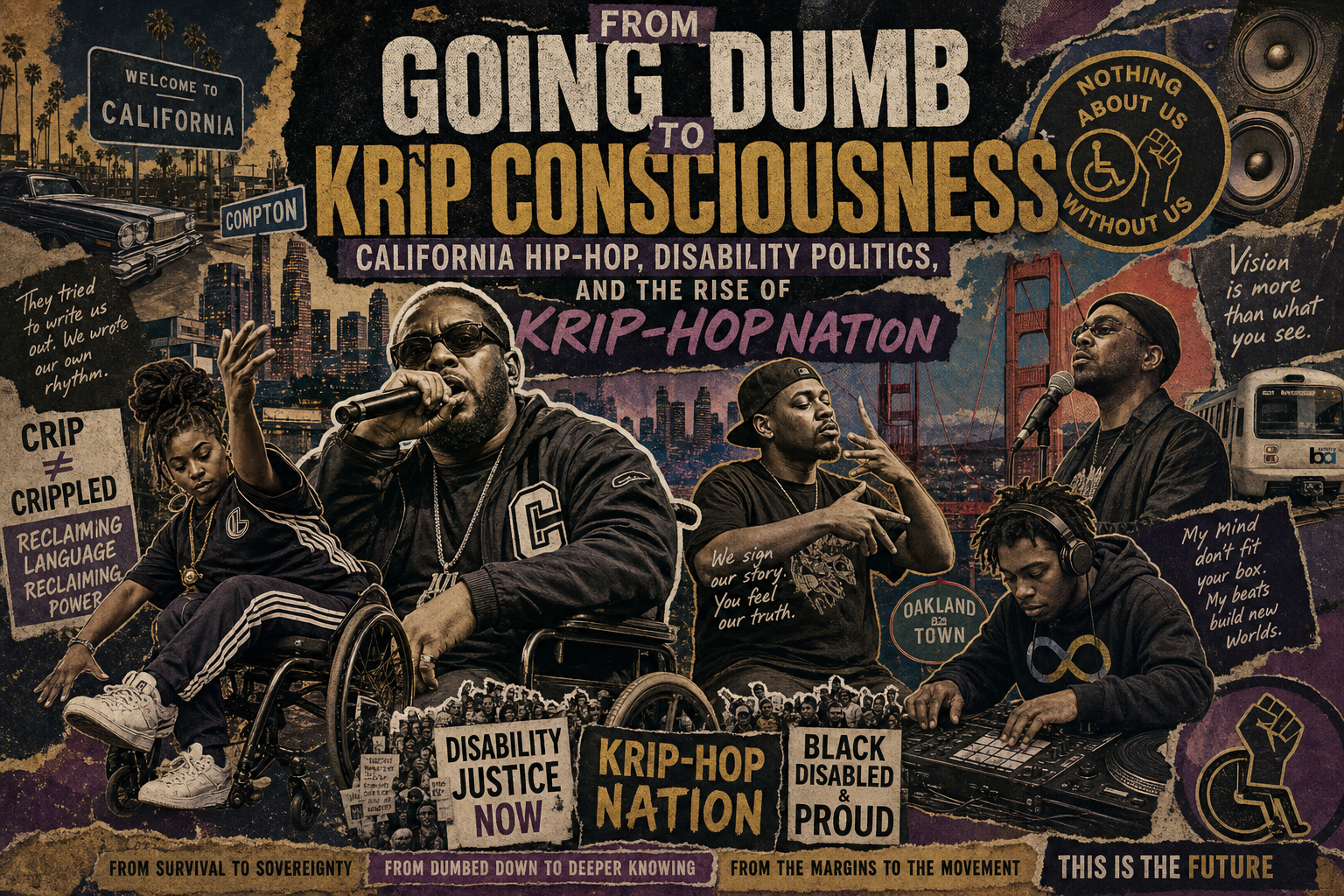
From “Going Dumb” to Krip Consciousness: California Hip-Hop, Disability Politics, and the Rise of Krip-Hop Nation
California Hip-Hop has long used disability language, imagery, and embodiment as part of its political aesthetics, street identity, humor, masculinity, and regional style. From gangsta rap in Los Angeles to hyphy culture in the Bay Area, terms associated with madness, impairment, instability, and bodily excess became metaphors for rebellion, survival, danger, and resistance to state control. Yet these same traditions rarely centered actual disabled people. Krip-Hop Nation intervenes by transforming disability from metaphor into lived political identity, artistic practice, and cultural theory.
West Coast gangsta rap often mobilized disability language to describe social conditions created by racism, policing, poverty, and urban abandonment. Artists connected psychological stress, trauma, and street violence to terms such as “crazy,” “insane,” “psycho,” “mental,” or “loc.” Groups like N.W.A framed Black urban rage through images of instability and uncontrollable behavior, while artists such as Tupac Shakur discussed the emotional and psychic effects of incarceration, police terror, and state violence. Disability language became part of the grammar of survival under racial capitalism, even when actual disabled communities remained invisible.
In Los Angeles gang culture, the figure of the “crazy” or “mad” gangster became associated with resistance to authority. Terms like “loc,” which circulated through Crip cultural formations, often implied both political disobedience and psychological unpredictability. The state already viewed Black communities as socially pathological; gangsta rap exaggerated and performed that stigma back toward the public. In this sense, disability functioned symbolically within Hip-Hop as a coded language of exclusion, pain, and alienation.
The Bay Area’s hyphy movement intensified these bodily and neurological metaphors through performance itself. Artists like E-40, Mac Dre, and Keak da Sneak cultivated styles built around bodily unpredictability, nonnormative movement, ecstatic dancing, slurred speech, asymmetrical rhythms, and forms of expression that mainstream culture often interpreted as irrational or out of control. “Going dumb,” “getting stupid,” and “going hyphy” represented refusals of respectability politics. The body moved outside normative discipline.
Hyphy culture is especially important for Krip-Hop analysis because it already challenged normative ideas about bodily control, communication, and acceptable movement. Turf dancing, stimming-like repetitive gestures, exaggerated mobility, and nonstandard vocal delivery disrupted dominant expectations of how Black bodies should behave in public. Yet even while hyphy embraced forms of bodily excess and social “abnormality,” disabled artists themselves remained marginal within the industry.
Krip-Hop Nation transforms this contradiction into political possibility. Rather than allowing disability to remain metaphorical, Krip-Hop insists that disabled people themselves must control the narrative, production, and aesthetics of disability in Hip-Hop culture. Krip-Hop asks: What happens when the people historically described as “crazy,” “slow,” “crippled,” “deaf,” “mad,” or “broken” become the theorists, MCs, DJs, dancers, and producers of Hip-Hop itself?
Artists connected to Krip-Hop Nation reclaim disability as both cultural identity and political analysis. Instead of disability functioning as insult or symbolism, Krip-Hop artists document police violence against disabled people, institutionalization, ableism in music industries, environmental racism, poverty, and medical neglect. Our work reframes disability not as individual tragedy but as a social condition produced through racism, capitalism, war, incarceration, and colonialism.
For example, disabled Black artists within Krip-Hop have critiqued how mainstream rap celebrates hypermasculine invulnerability while ignoring chronic illness, mental health struggles, mobility impairments, deaf culture, neurodivergence, and trauma within Black communities. Krip-Hop artists also expose how the music industry routinely excludes disabled performers from touring, production spaces, and visual representation.
The career of Keak da Sneak offers a strong example of this transition. After being shot and becoming partially paralyzed, Keak continued performing and recording while navigating disability publicly. His survival complicated dominant rap narratives that equate masculinity solely with physical invincibility. Krip-Hop analysis does not romanticize injury; rather, it recognizes how disabled embodiment reshapes artistic identity and exposes the fragility underlying gangsta and hyphy performance traditions.
Similarly, Krip-Hop opens space for Deaf MCs, autistic beatmakers, blind poets, wheelchair dancers, and neurodivergent performers whose artistry has historically been excluded from Hip-Hop’s commercial image. The movement expands Hip-Hop politics beyond representation alone by arguing that disabled artistic practices generate new forms of rhythm, sound, access, communication, and collective care.
Krip-Hop also critiques how mainstream rap continues to weaponize ableist language while profiting from aesthetics rooted in social trauma. Terms like “crazy,” “retarded,” “lame,” “crippled,” or “psycho” circulate casually throughout Hip-Hop history, but Krip-Hop reframes these terms historically and politically. It asks listeners to recognize that many behaviors criminalized or mocked in Black communities are connected to disability, trauma, environmental violence, and survival under racial oppression.
By “kripping” California Hip-Hop, Krip-Hop Nation does not reject gangsta rap or hyphy culture outright. Instead, it rereads them through Black disability politics. It argues that beneath the performance of toughness, chaos, and hypermobility were already deeper stories about pain, survival, embodiment, mental health, and social abandonment. Krip-Hop transforms those hidden disability narratives into explicit political consciousness led by disabled artists themselves.
In this sense, Krip-Hop becomes the next evolution of California Hip-Hop politics: moving from disability as metaphor toward disability as liberation struggle, cultural production, and radical Black artistic knowledge.