From Berkeley to the World: How Krip-Hop Nation Transformed Underground Hip-Hop, Disability Culture, and Hip-Hop Studies
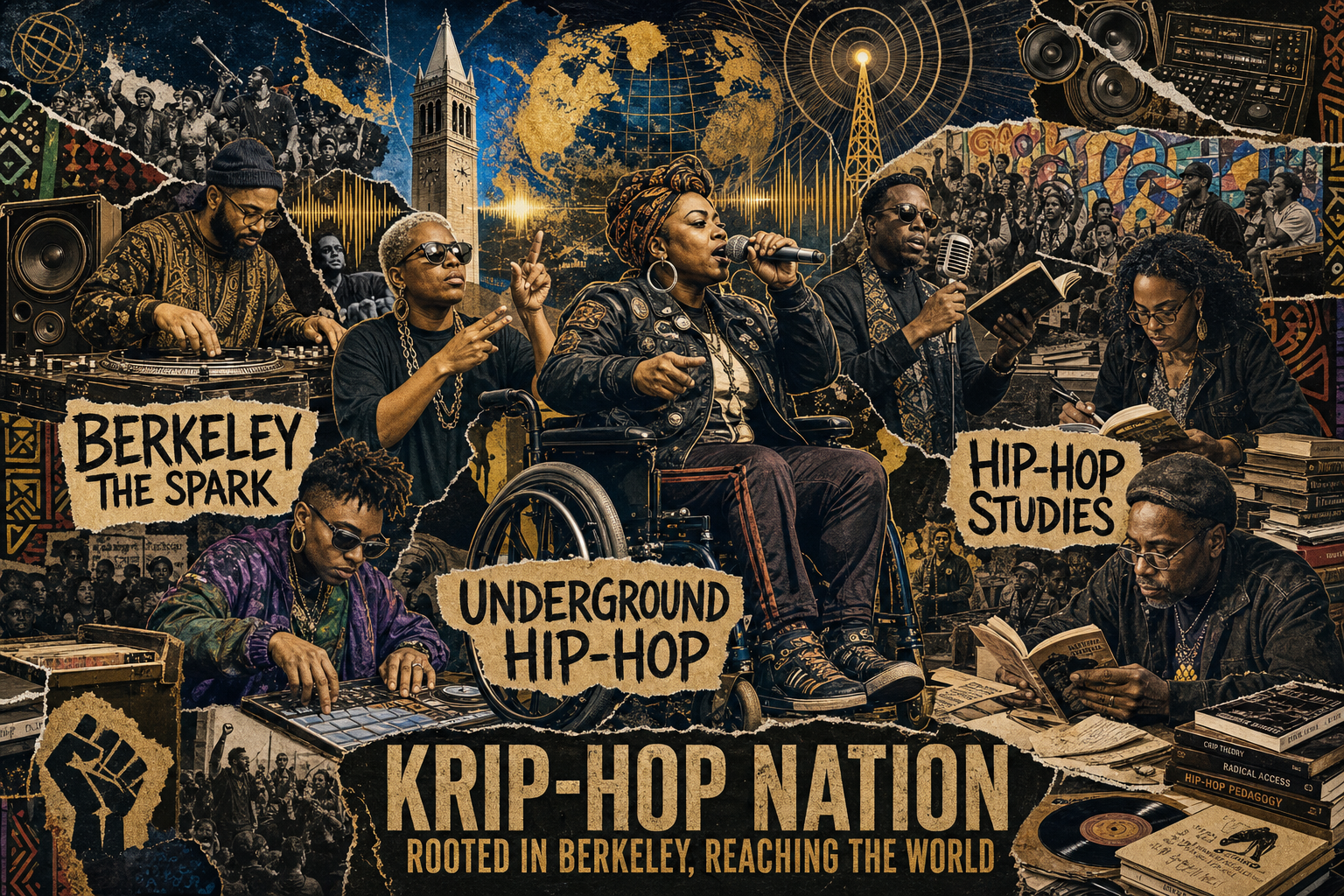
Krip-Hop Nation’s impact can be understood in three interconnected areas: Berkeley, underground Hip-Hop, and Hip-Hop Studies. What began as a local cultural intervention in Berkeley grew into an international movement that challenged ableism in music, expanded disability culture within Hip-Hop, and helped create new directions in scholarship.
How Krip-Hop Nation Changed Berkeley
Berkeley has long been known for disability rights activism, but before Krip-Hop Nation there was little public attention given to disabled Hip-Hop artists. Through KPFA’s Pushing Limits radio program, Leroy Moore introduced the concept of “Krip-Hop” to Bay Area audiences in the early 2000s. The response led to the creation of Krip-Hop Nation and transformed Berkeley into a center for Black disability arts, disability culture, and Hip-Hop activism.
Krip-Hop Nation brought together communities that were often separated: disability activists, underground Hip-Hop artists, queer artists, Black cultural workers, and university scholars. Events such as the “Diversifying Hip-Hop: Krip-Hop and Homo-Hop” conference at the University of California, Berkeley challenged mainstream Hip-Hop culture to confront ableism alongside racism, sexism, and homophobia.
In many ways, Krip-Hop helped establish Berkeley as a place where disability could be discussed not only through policy and access but through music, poetry, performance, and Black cultural production.
How Krip-Hop Nation Changed Underground Hip-Hop
Krip-Hop Nation changed underground Hip-Hop by creating a space where disabled artists could tell their own stories rather than being represented by non-disabled people. It challenged the widespread use of disability slurs and stereotypes in rap lyrics while proving that disability could be a source of political analysis, creativity, and resistance.
The movement expanded Hip-Hop’s political vocabulary by bringing issues such as:
- Police brutality against disabled people
- Institutionalization
- Ableism in Black communities
- Disability and poverty
- Disability and race
- Disability justice
into rap music and cultural organizing.
Krip-Hop also built an international network of disabled artists across the United States, Germany, South Africa, Zimbabwe, Tanzania, Brazil, Spain, and other countries, creating one of the first global disability-centered Hip-Hop movements.
How Krip-Hop Nation Changed Hip-Hop Studies
Perhaps Krip-Hop Nation’s most lasting contribution is its influence on scholarship. Before Krip-Hop, disability was largely absent from Hip-Hop Studies. The movement forced scholars to ask new questions:
- Where are disabled people in Hip-Hop history?
- How does ableism shape Hip-Hop culture?
- What happens when Black Studies, Disability Studies, and Hip-Hop Studies intersect?
- How do disabled artists reshape ideas of authenticity, resistance, and community?
These questions helped create what is now emerging as Krip-Hop Theory, Afro-Krip theory, and disability-centered Hip-Hop scholarship. Krip-Hop Nation has brought these discussions into universities through lectures, conferences, curriculum development, ethnomusicology, anthropology, and plans for the Krip-Hop Institute.
Today, Krip-Hop’s influence can be seen in growing academic interest in Black disability culture, disability justice, and the role of disabled artists in Hip-Hop history.
Krip-Hop Nation’s Biggest Achievements
Creating the world’s first international network of disabled Hip-Hop artists. Krip-Hop Nation connected hundreds of artists with disabilities across multiple continents and established disability as a legitimate cultural force within Hip-Hop.
Bringing disability into Hip-Hop discourse. The movement challenged ableist language and stereotypes while centering disabled artists as creators rather than subjects of charity or inspiration narratives.
Organizing groundbreaking conferences and performances. Krip-Hop held conferences at institutions including the University of California, Berkeley, New York University, and Yale, and performed at international disability arts festivals in places such as Liverpool, South Africa, Toronto, Canada, and Atlanta.
Producing international music projects. Krip-Hop released mixtapes and collaborative albums, including projects addressing police brutality and profiling of disabled people, bringing together artists from the U.S., U.K., and Germany.
Influencing university scholarship. Krip-Hop helped open space for disability-centered Hip-Hop research and contributed to the development of new frameworks linking Black Studies, Disability Studies, ethnomusicology, and Hip-Hop Studies.
Contributing to the award-winning Rising Phoenix project. Krip-Hop artists contributed to music connected to the Paralympic documentary Rising Phoenix, helping bring disabled musicians to a global audience.
Building toward the Krip-Hop Institute. The creation of the Krip-Hop Institute represents an effort to institutionalize Black disability arts, Hip-Hop scholarship, archiving, education, and community organizing for future generations.
Creating a new cultural and political identity. One of Krip-Hop Nation’s greatest achievements may be conceptual rather than organizational: transforming “crip” into “Krip” and creating a cultural identity that links disability, Blackness, resistance, music, and self-determination.
In short, Krip-Hop Nation did more than create a music collective. It helped transform Berkeley’s cultural landscape, expanded the possibilities of underground Hip-Hop, and opened an entirely new field of inquiry within Hip-Hop Studies by insisting that disabled people are not outside Hip-Hop history—they have always been part of it.