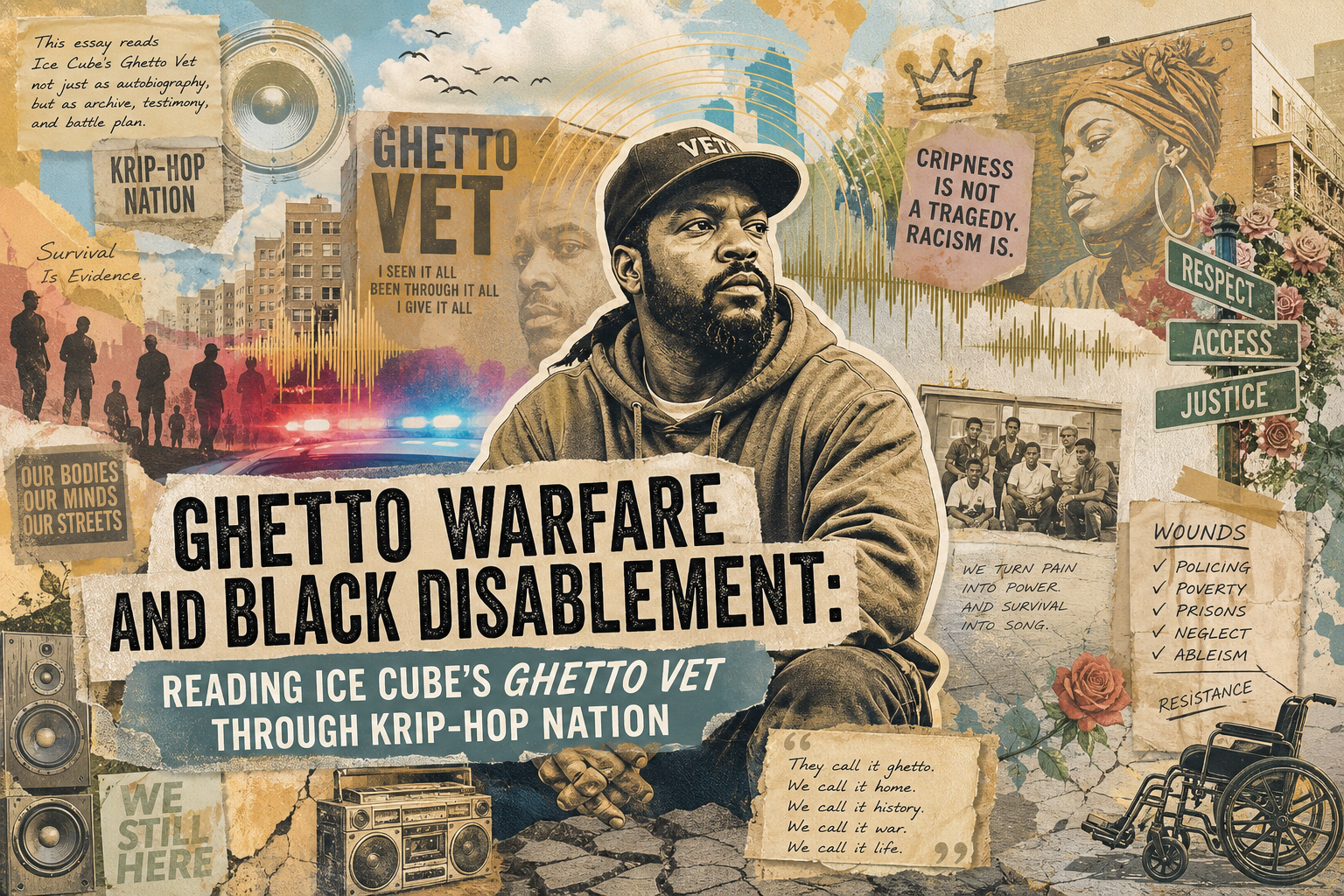
“Ghetto Warfare and Black Disablement: Reading Ice Cube’s ‘Ghetto Vet’ Through Krip-Hop Nation”
Ice Cube’s song “Ghetto Vet” from the album War & Peace Vol. 1 (The War Disc) can be read through the lens of Krip-Hop Nation as a powerful articulation of Black debility, urban survival, militarized masculinity, and the embodied consequences of racial capitalism. Although Ice Cube was not consciously working within disability studies or Krip-Hop theory, the song reflects many of the social realities that Krip-Hop Nation later theorized: the relationship between systemic violence, trauma, criminalization, and the production of disabled Black life.
“Ghetto Vet” is important because Ice Cube positions himself as a “veteran” not of a foreign war but of the inner city. This reframes the ghetto as a war zone where Black people survive ongoing state violence, policing, poverty, gang conflict, and psychological trauma. Krip-Hop Nation extends this analysis by arguing that these conditions produce forms of disability and debility that mainstream Hip-Hop often leaves unnamed.
The term “vet” itself is significant. Traditionally, a veteran is someone physically or psychologically marked by war. In “Ghetto Vet,” the Black urban subject becomes a survivor of domestic warfare. This mirrors what Krip-Hop scholars describe as socially produced disablement: disability not merely as a medical condition, but as the outcome of racist structures, environmental neglect, police violence, incarceration, addiction, and economic abandonment.
The song’s aggressive delivery, paranoia, hypervigilance, and militarized language can also be interpreted through Afro-Krip theory. The narrator moves through space as someone conditioned by constant threat. Krip-Hop Nation asks us to hear these performances not simply as “gangsta rap bravado,” but as embodied responses to trauma and social containment. The “ghetto vet” becomes a disabled survivor of American racial warfare.
This connects strongly to the work of Bradley Lomax and I, both of whom highlight how Black disabled people have historically existed inside movements against racism while often remaining invisible within Black political discourse. Krip-Hop Nation argues that many Black communities experience disability collectively through state neglect, yet disability remains stigmatized or hidden because of Black ableism and pressures around masculinity.
Ice Cube’s performance of hardness in “Ghetto Vet” also reflects this contradiction. The song expresses vulnerability through the language of toughness. The body is exhausted, traumatized, and under siege, yet masculinity demands emotional invulnerability. Krip-Hop theory critiques this dynamic by examining how Black men are denied softness, care, interdependence, and disabled identity. In this reading, “Ghetto Vet” becomes a testimony of wounded Black masculinity disguised as militant strength.
The song also fits into Krip-Hop Nation through sound and narration. Krip-Hop scholars often argue that Hip-Hop archives pain sonically: breathing patterns, vocal stress, repetition, aggression, fragmented storytelling, and bodily metaphors communicate forms of embodied suffering that traditional scholarship overlooks. Ice Cube’s cadence and imagery carry the weight of survival fatigue, state surveillance, and historical memory.
Additionally, “Ghetto Vet” can be connected to the concept of debility developed by disability theorist Jasbir Puar. Puar distinguishes between recognized disability and debility produced through slow structural violence. Krip-Hop Nation expands this concept into Black communities by showing how policing, environmental racism, poor healthcare, incarceration, and poverty create chronic physical and psychological impairment without necessarily being named as disability.
From a Krip-Hop perspective, “Ghetto Vet” is therefore not only a gangsta rap song. It is an archive of Black urban disablement, survival, and embodied resistance. The song unintentionally documents how Black communities navigate trauma while masking vulnerability through performance, style, humor, militancy, and lyrical aggression.
The track also helps expand Hip-Hop studies itself. Traditional Hip-Hop scholarship often focused on race, class, authenticity, and resistance, but Krip-Hop Nation adds disability, chronic trauma, mental health, embodiment, and Black ableism to the analysis. Reading “Ghetto Vet” through Krip-Hop theory reveals how disability is already embedded within Hip-Hop narratives even when the language of disability is absent.
In this way, “Ghetto Vet” becomes part of a larger Krip-Hop archive: music that documents the bodily costs of surviving anti-Blackness in America.