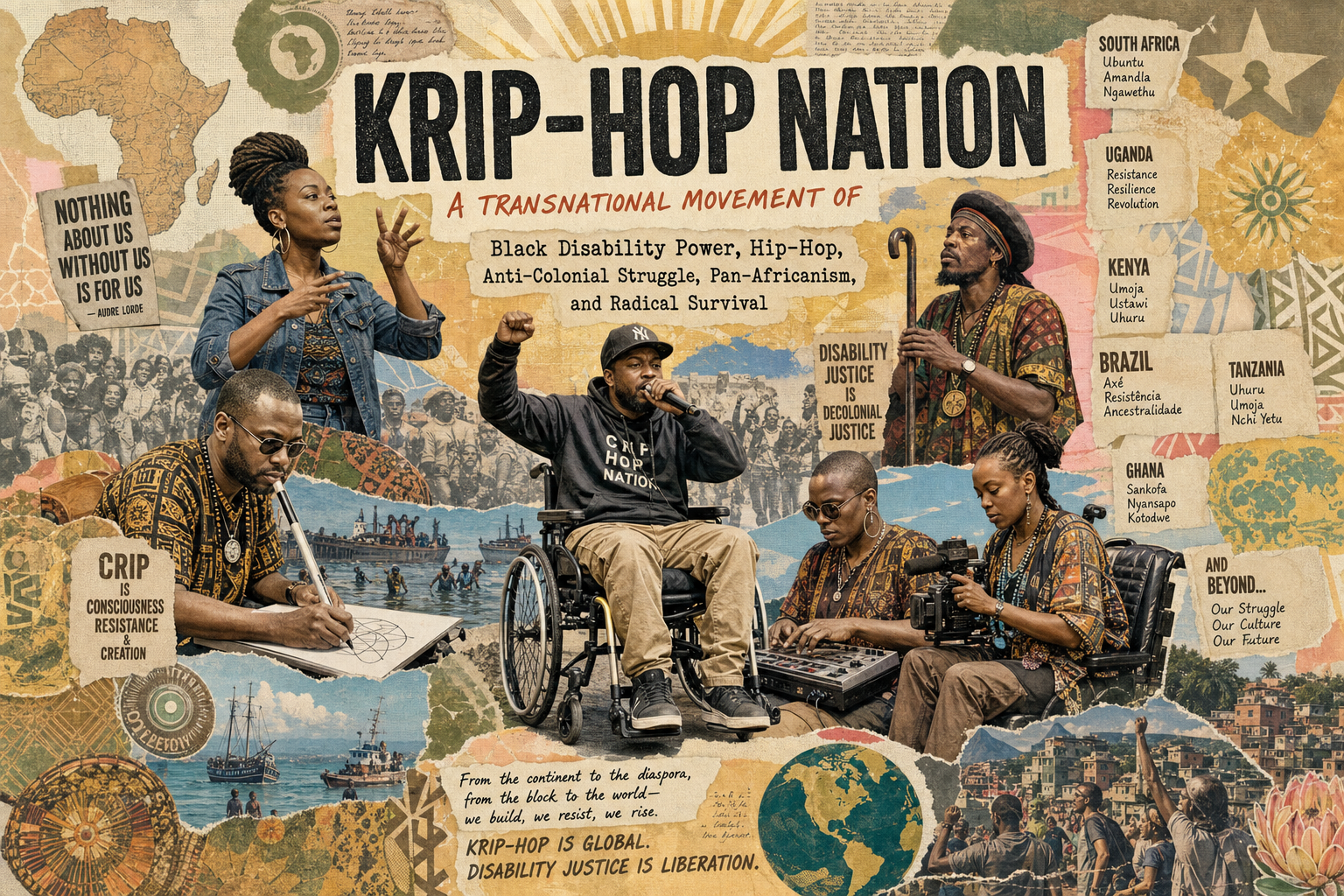
Krip-Hop Nation: Toward an Afro-Krip Pan-Africanism
Krip-Hop Nation emerged as more than a music movement. It became a transnational political and cultural intervention connecting Black disability politics, Hip-Hop, anti-colonial struggle, and radical survival. Krip-Hop Nation insists that disability cannot be separated from racism, colonialism, capitalism, policing, war, environmental violence, and cultural erasure. Through music, performance, activism, and global organizing, Krip-Hop Nation exposes how ableism operates differently across the African diaspora while still being tied to the same colonial systems.
The movement’s international work across South Africa, Uganda, Kenya, Brazil, Tanzania, and the United States reflects a broader political question: what does liberation mean if disabled Black people remain excluded from the future being imagined? Krip-Hop Nation argues that anti-colonial struggle and Black liberation must include disability justice or else they risk reproducing new forms of exclusion.
Colonialism and the Production of Disability
European colonialism imposed racial hierarchies while also imposing bodily hierarchies. Colonial governments often treated disabled Africans as economically useless, spiritually cursed, socially disposable, or outside modern citizenship altogether. Missionary systems frequently framed disability through pity and charity instead of political humanity. Colonial capitalism measured human value through labor extraction, military usefulness, and productivity. Those who could not fit these standards were often marginalized from public life.
This history reveals that colonialism itself was a disability-producing system. Forced labor, slavery, mining industries, environmental destruction, war, imprisonment, malnutrition, and medical neglect produced widespread bodily harm across Africa and the African diaspora. Disability was not outside colonialism; it was one of colonialism’s consequences.
The work of Frantz Fanon helps explain this process. Fanon argued that colonialism reorganizes the body itself through racial domination. In Black Skin, White Masks, he described how Black people were forced to experience themselves through what he called the “epidermal racial schema,” where white colonial perception shaped Black existence. Krip-Hop Nation extends Fanon’s framework by showing that disabled Black bodies are also trapped within an ableist colonial schema. Disabled Africans become hypervisible as objects of pity while simultaneously erased from national narratives of citizenship, labor, and modernity.
Krip-Hop Nation interrupts this colonial body politics by centering disabled African artists as theorists, creators, and political agents rather than objects of charity. Hip-Hop becomes a method of reclaiming the disabled Black body from colonial silence.
Kwame Nkrumah and the Question of Disability
The legacy of Kwame Nkrumah remains essential to understanding this struggle. As the first president of Ghana and one of the architects of modern Pan-Africanism, Nkrumah argued that colonialism was not simply foreign occupation but a total system shaping economics, culture, consciousness, and social value. Although Nkrumah did not develop a formal disability theory, his anti-colonial philosophy provides an important foundation for Afro-Krip politics.
Nkrumah believed African liberation required restoring African humanity beyond colonial definitions of value. His vision of Pan-Africanism rejected colonial hierarchies and called for collective responsibility, cultural sovereignty, and political unity. This framework creates important possibilities for disability justice because it challenges the colonial logic that only productive, able-bodied people deserve dignity and citizenship.
Between 1961 and 1966, Kwame Nkrumah’s government in Ghana implemented one of the most significant disability rehabilitation efforts in postcolonial Africa. Rather than treating disabled people merely through charity or welfarism, Nkrumah’s administration viewed rehabilitation as part of the national “big push” toward industrialization and economic modernization. Rehabilitation centers and vocational programs were designed to integrate disabled citizens into the national economy as productive workers participating in socialist development and nation-building. This approach was unique among newly independent African states because it linked disability directly to anti-colonial development rather than isolating it as a private medical or charitable issue. Although the program still reflected certain productivity-centered assumptions of the era, it nevertheless represented an important break from colonial systems that rendered disabled Africans socially disposable.
Krip-Hop Nation builds on this unfinished legacy by extending Pan-Africanism into disability politics. Where Nkrumah fought for political and economic liberation from colonial rule, Krip-Hop asks what liberation means for disabled Black people who remain marginalized even after formal independence. Krip-Hop argues that decolonization must also dismantle ableism inherited through colonial institutions, missionary ideologies, capitalist development models, and nationalist ideas of bodily strength.
In many ways, Krip-Hop Nation expands Nkrumah’s rehabilitation vision beyond economic inclusion alone toward cultural, artistic, and political liberation. Where Nkrumah’s rehabilitation programs sought to integrate disabled people into the postcolonial workforce, Krip-Hop Nation insists that disabled Black people must also be recognized as intellectuals, cultural producers, theorists, organizers, and leaders within Pan-African struggle itself. The movement argues that disabled Black people are not simply laboring bodies to be rehabilitated into productivity, but revolutionary voices capable of reshaping the meaning of liberation.
Nkrumah also viewed culture as a revolutionary weapon. He believed music, education, literature, and political consciousness were central to resisting neo-colonial domination. Krip-Hop Nation expands this cultural struggle by placing disabled Black artists at the center of global resistance movements. Through rap, spoken word, film, and performance, Krip-Hop artists create an Afro-Krip Pan-Africanism where disabled Black people become producers of revolutionary culture rather than symbols of tragedy.
Krip-Hop Nation also extends Nkrumah’s critique of neo-colonialism into modern disability charity systems. International NGOs often portray disabled Africans as helpless victims needing rescue from the West. Krip-Hop rejects these paternalistic narratives by insisting on self-representation, political agency, and cultural autonomy. In this way, the movement continues Nkrumah’s warning that colonialism can survive through economic dependency, humanitarian control, and global media representation even after independence.
Black Ableism in the United States
While colonialism shaped disability oppression globally, Black communities in the United States developed their own internal tensions around disability under white supremacy. Black survival in America often depended on appearing strong, disciplined, productive, masculine, and resistant. Because racism historically portrayed Black people as biologically inferior, disability and vulnerability sometimes became stigmatized within Black political and cultural spaces.
Krip-Hop Nation critiques this dynamic while recognizing that Black ableism itself developed under anti-Black oppression. Mainstream Hip-Hop culture frequently used disability language as metaphors for weakness, failure, or insanity. Hypermasculinity, bodily invulnerability, and toughness became dominant cultural ideals, often leaving little room for disabled Black expression.
Krip-Hop Nation challenges these traditions by insisting that vulnerability itself contains political knowledge. Disabled Black people are not outside Black liberation struggles; they reveal the deepest contradictions within them.
This intervention connects deeply to the work of Tommy J. Curry and Black Male Studies, which examines how Black men experience racialized vulnerability, disposability, and state violence under white supremacy. Curry argues that Black men are often imagined only through stereotypes of danger, aggression, and hypermasculinity while their pain, victimization, disability, and emotional vulnerability are erased. Krip-Hop Nation extends Curry’s framework into disability politics by showing how disabled Black men exist at the intersection of anti-Black racism and ableism.
Within both mainstream society and some Black political spaces, disabled Black men are frequently judged against ideals of physical strength, labor productivity, toughness, and masculine endurance. Those who cannot perform these expectations are often marginalized or rendered invisible. Krip-Hop Nation resists this erasure by centering disabled Black men as artists, theorists, intellectuals, and survivors whose lived experiences expose the violence of both racism and ableism.
When Colonialism and Black Ableism Collide
Krip-Hop Nation’s most important intervention may be its analysis of what happens when colonial ableism in Africa collides with Black ableism in the United States. Disabled Africans often encounter Western humanitarian systems that frame them as passive victims requiring charity and rescue. At the same time, disabled Black people in the United States may encounter Black cultural spaces that celebrate racial resistance while still marginalizing disability.
This collision produces a double exclusion. Disabled Black people become erased by both colonial narratives and internalized ableist politics.
Krip-Hop Nation refuses both frameworks. The movement argues that disability is not marginal to Black history but central to it. Slavery, colonization, war, environmental racism, police violence, labor exploitation, and poverty have all produced disability throughout the African diaspora. Black history itself cannot be understood apart from bodily vulnerability and survival.
John Langston Gwaltney helps explain this contradiction through what he called the “race game,” where Black people constantly negotiate white social power while navigating tensions inside Black communities themselves. Krip-Hop Nation expands Gwaltney’s insight by showing that disabled Black people must navigate both the race game and the ability game simultaneously. They confront racism from dominant society while also confronting ableism within Black spaces.
This becomes especially visible through international Krip-Hop collaborations between disabled African artists and African American disabled artists. Different histories of colonialism, poverty, race, masculinity, language, and disability stigma emerge, yet so do shared experiences of exclusion and resistance. Krip-Hop transforms these encounters into political solidarity rather than division.
Toward an Afro-Krip Future
Krip-Hop Nation ultimately proposes a new political vision: Afro-Krip politics. This framework links Black disability experience across continents while recognizing local differences in culture and history. It insists that anti-colonial struggle, Pan-Africanism, Hip-Hop politics, and Black liberation movements must confront ableism directly.
In this way, Krip-Hop Nation does not reject the legacy of Nkrumah or earlier Black radical traditions; it radicalizes and expands them. It asks what Pan-Africanism looks like when Deaf, blind, neurodivergent, chronically ill, mobility-impaired, mad, and disabled Black people are placed at the center of liberation struggles rather than pushed to the margins.
Krip-Hop transforms disability from a site of shame into a site of political consciousness, cultural production, and revolutionary possibility. Through this Afro-Krip vision, the movement redefines liberation itself, not as freedom only for the strong, productive, or able-bodied, but as collective freedom for all Black people across the diaspora.